
What Is the Biggest Complaint After Knee Replacement? | Dr. Sukesh Reddy P, Warangal
Struggling with joint pain? Learn when arthroscopy is the right option. Dr. Sukesh Reddy P at Fathima Hospital, Warangal offers advanced minimally invasive surgery.
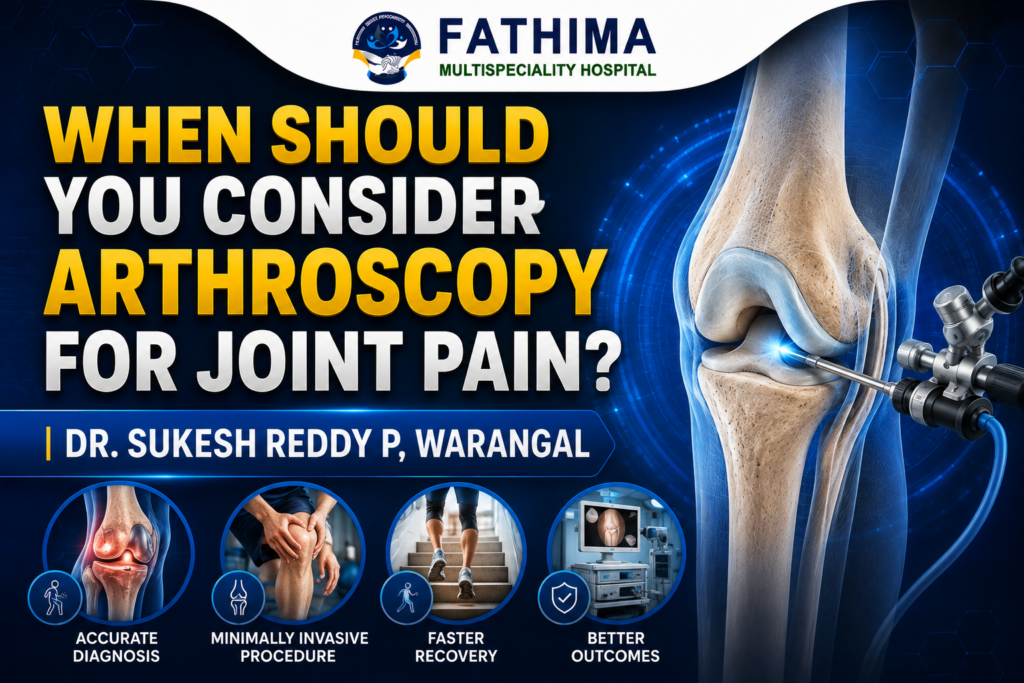
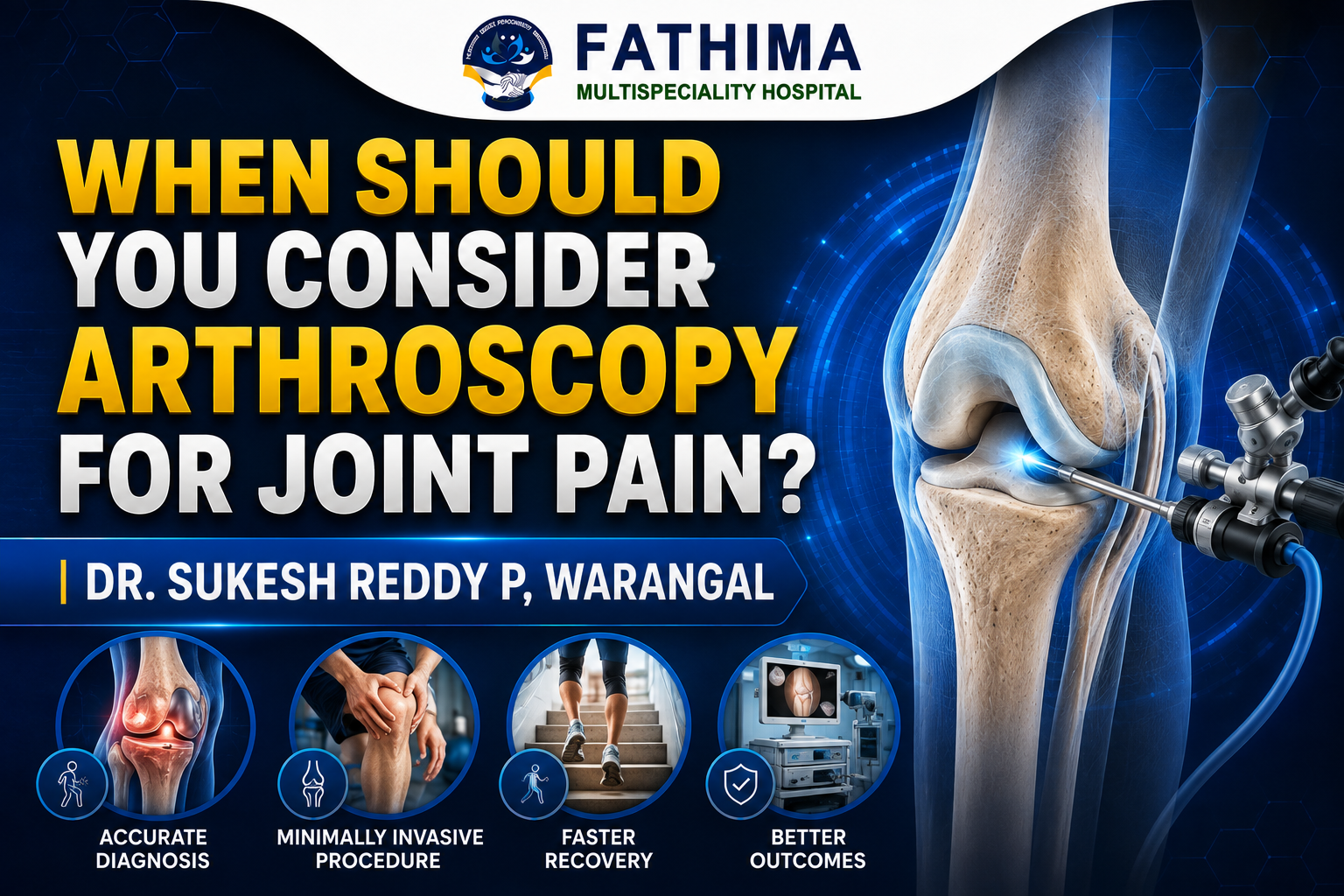
Arthroscopy is worth considering when joint pain, swelling, stiffness, or instability continues despite rest, medication, and physiotherapy — especially if there are mechanical symptoms like clicking, catching, or locking. At Fathima Multispeciality Hospital, Warangal, Dr. Sukesh Reddy P (MS Orthopaedics) evaluates these symptoms and performs advanced arthroscopic surgery to diagnose and treat joint damage through minimally invasive techniques.
Joint pain rarely announces itself all at once — it usually creeps in. Climbing stairs starts to hurt. A jog turns into a limp. Getting up from a chair takes an extra second. For many patients, this is the point where arthroscopy becomes worth discussing with an orthopaedic specialist.
Arthroscopy is a minimally invasive surgical technique used to diagnose and treat problems inside a joint. A tiny camera called an arthroscope is inserted through a small incision, allowing the surgeon to view the joint directly on a screen — and in many cases, treat the problem in the same procedure.
Compared to traditional open surgery, arthroscopy offers:
At Fathima Multispeciality Hospital, arthroscopic procedures are performed using modern operation theatres and advanced imaging, giving Dr. Sukesh Reddy P the precision needed to identify and correct joint issues with minimal disruption to surrounding tissue.
i. Persistent Joint Pain
Pain that continues for weeks or months despite medication, rest, or physiotherapy is a common trigger for further evaluation.
ii. Swelling or Stiffness
Ongoing inflammation that limits how far you can move the joint often points to internal damage that imaging and arthroscopy can clarify.
iii. Joint Instability
A knee, shoulder, or ankle that feels like it’s “giving way,” or that dislocates repeatedly, usually needs a closer surgical look.
iv. Mechanical Symptoms
Clicking, catching, or locking during movement often signals torn cartilage or loose fragments inside the joint — something arthroscopy can both diagnose and treat.
v. Injury-Related Damage
Ligament tears, meniscus injuries, or cartilage damage from sports or accidents frequently require arthroscopic assessment to determine the extent of injury.
If any of these symptoms sound familiar, a consultation with Dr. Sukesh Reddy P at Fathima Multispeciality Hospital can help determine whether arthroscopy is the right next step.
Arthroscopy isn’t limited to one part of the body. Depending on the condition, it can be used on:
Knee — meniscus tears, ligament injuries (including ACL), and cartilage damage, common in sports injuries
Shoulder — rotator cuff tears, impingement, and labral tears
Hip — labral tears, femoroacetabular impingement, and early-stage joint damage
Elbow, Wrist, and Ankle — chronic pain, stiffness, and sports-related injuries
Each procedure is planned around the patient’s specific anatomy and diagnosis to ensure the most accurate and least invasive treatment possible.
At Fathima Multispeciality Hospital, these outcomes are supported by the hospital’s investment in advanced surgical technology and Dr. Sukesh Reddy P‘s experience in joint-preserving and minimally invasive orthopaedic procedures.
i. Follow your surgeon’s instructions closely — medication, dressing care, and activity limits matter in the first few weeks.
ii. Start physiotherapy early — guided rehab is often what separates a good recovery from a great one.
iii. Watch for warning signs — unusual swelling, fever, or increasing pain should be reported immediately.
iv. Stay consistent — joint-friendly exercise and a healthy weight help protect long-term joint health.
Persistent joint pain doesn’t have to be something you simply live with. Whether it’s from a sports injury, an old accident, or gradual wear and tear, arthroscopy offers a minimally invasive way to diagnose the problem accurately and treat it in the same procedure — often with a much shorter recovery than traditional surgery.
At Fathima Multispeciality Hospital, Warangal, Dr. Sukesh Reddy P combines advanced surgical technology with a patient-focused approach to help you move without pain again. If joint pain, stiffness, or instability is affecting your daily life, don’t wait — an expert evaluation could be your first step back to full mobility.
Call: +9194947 32200
Visit: H No 1-1-1106, Beside Over Bridge Sidharthnagar, Street No 7, Hanamkonda, Telangana – 506004
Google Location : https://share.google/kWBZtpRmM3qDsgHUO
Frequently Asked Questions (FAQ’s)
1Q: Is arthroscopy safe?
Ans: Yes, arthroscopy is generally very safe. Minor risks like infection or stiffness are further reduced when performed by an experienced surgeon such as Dr. Sukesh Reddy P.
2Q: Who performs arthroscopic surgery in Warangal?
Ans: Dr. Sukesh Reddy P (MS Orthopaedics) performs arthroscopic surgery at Fathima Multispeciality Hospital, Warangal, using advanced diagnostic and surgical technology.
H No 1-1-1106, Beside Over Bridge Sidharthnagar, Street No 7, Hanamkonda, Telangana - 506004