
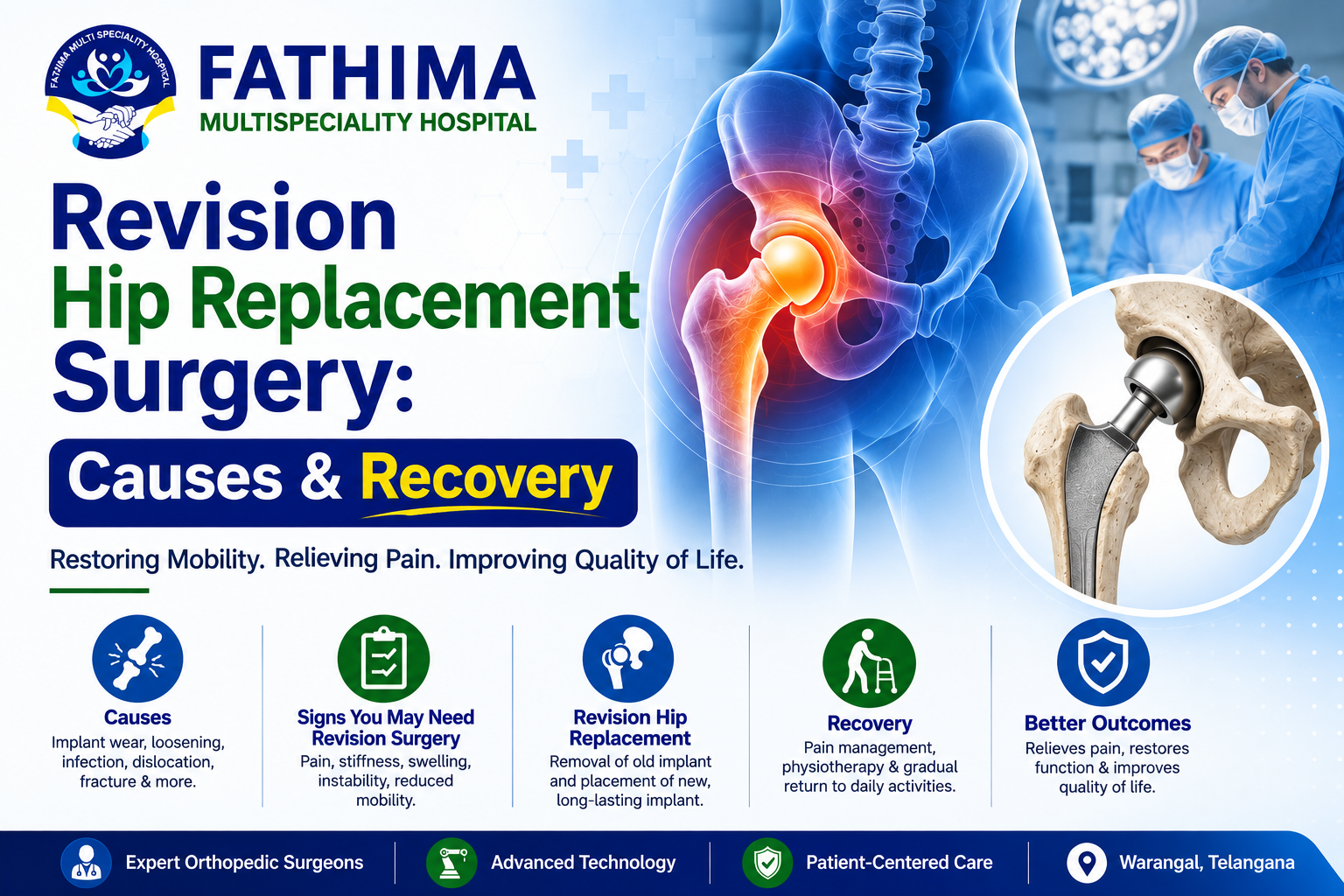
Revision Hip Replacement Surgery: Causes & Recovery

“I’ll just skip the warm-up today — I’m already late and I know the exercises.” Sound familiar? That single decision, made in a rushed moment, is responsible for a significant portion of gym injuries that walk through our orthopaedic doors.
At Fathima Multispeciality Hospital in Warangal, Dr. Sukesh Reddy P and the orthopaedic team see the consequences of this habit regularly — torn ligaments, damaged cartilage, stressed tendons, and inflamed joints in patients who were otherwise fit, active, and healthy. The injury didn’t happen because they were unfit. It happened because their body wasn’t prepared.
Here is the complete picture of what actually happens inside your joints when you skip the warm-up — and how to protect yourself every single time you train.
Synovial Fluid
Cold joints have thick, sluggish synovial fluid. It takes 5–8 minutes of movement to circulate properly and lubricate cartilage surfaces — without this, bone-on-bone friction is much higher.
Muscle Elasticity
Cold muscles are short, tight, and inelastic. They cannot absorb the explosive forces of lifting or sprinting, transferring that stress directly to ligaments and tendons.
Blood Flow
Without warm-up, oxygen-rich blood hasn’t reached working muscles. Oxygen-deprived muscles fatigue faster, lose coordination, and are far more injury-prone under load.
Neuromuscular Prep
Your brain-to-muscle communication needs activation. Cold muscles have slower neural response times, poor coordination, and reduced balance — a dangerous combination under heavy weights.
01: ACL and Ligament Tears — The Gym’s Most Feared Injury
The Anterior Cruciate Ligament (ACL) stabilises the knee during rotation and sudden changes in direction. Without a warm-up, ligaments are stiff, inelastic, and cannot handle the sudden torque of a squat, lunge, or lateral movement. A single misstep — even a minor one — can snap a cold ligament that would have absorbed the force had it been properly prepared. ACL tears require surgical reconstruction and months of rehabilitation.
02: Rotator Cuff Tears — The Shoulder Injury You Don’t Feel Coming
The shoulder is the most mobile and most unstable joint in the body. Jumping straight into bench press, overhead press, or pull-ups with cold rotator cuff muscles dramatically increases the risk of partial or complete tears. These injuries are notoriously slow to heal, often requiring surgery, and they permanently limit your ability to train overhead if left untreated or treated late.
03: Meniscus Damage — The Knee Cartilage You Only Have Once
The meniscus acts as a shock absorber in the knee. When you perform weighted squats, deadlifts, or plyometrics without warming up, the unprepared meniscus is exposed to compressive forces it cannot safely distribute. Tears range from minor fraying (manageable with physiotherapy) to complete bucket-handle tears requiring arthroscopic surgery. Once significantly damaged, the meniscus cannot fully regenerate — making prevention absolutely critical.
04: Tendinitis and Tendon Rupture — The Overloaded Connectors
Tendons connect muscle to bone and transmit the force your muscles generate. Cold tendons are brittle and have poor tensile strength. Loading them immediately with heavy weights — especially in exercises like calf raises, bicep curls, or squats — causes micro-tears that accumulate into tendinitis, or in severe cases, a complete rupture. Achilles tendon and patellar tendon ruptures are two of the most debilitating gym injuries seen in young, otherwise healthy patients.
05: Lower Back Injuries — The Spine’s Vulnerability Under Cold Load
Deadlifts, rows, and compound movements demand a stable, well-activated core and mobile lumbar spine. Without warm-up, the spinal erectors are tight, the intervertebral discs are not yet properly hydrated and pressurised, and the core cannot fire correctly. The result: one poorly executed rep under load can herniate a disc, strain a spinal ligament, or compress a nerve — causing pain that can last months or permanently alter your training capacity.
Myth
“I’ve been training for years — my body is conditioned enough that I don’t need to warm up.”
Fact
Conditioning improves strength — not cold-tissue resilience. Elite athletes warm up extensively precisely because their training loads are higher and the injury stakes are greater.
Myth
“Static stretching before gym counts as a warm-up.”
Fact
Static stretching cold muscles can actually increase injury risk. Dynamic warm-up — movement-based activation — is what raises joint temperature, circulates synovial fluid, and wakes up the neuromuscular system.
i. Light Cardio Activation 3 min
Brisk walk, light jog, cycling, or jumping jacks. Goal: raise core body temperature and begin synovial fluid circulation throughout major joints.
ii. Dynamic Joint Mobility 3 min
Controlled arm circles, hip circles, leg swings, ankle rotations, and wrist rolls. Move each joint through its full range of motion — never force. This prepares cartilage and lubricates joint capsules.
iii. Movement-Specific Activation 2 min
Mimic the workout movements at zero or very low load. Squatting day? Do 10 bodyweight squats slowly. Shoulder day? Perform band pull-aparts and wall slides. This fires the exact muscles and joints you’re about to train.
iv. Progressive Load Ramp-Up 2 min
Start your first working set at 40–50% of your target weight. Increase gradually to working weight over 2–3 sets. This is the final, critical phase most gym-goers skip — jumping straight to maximum load is when injuries occur even with a general warm-up done.
The 10 Minutes That Protect a Lifetime of Training
Every set you lift, every kilometre you run, every class you attend is an investment in your health. A warm-up is not optional extra time — it is the insurance policy on that investment. The evidence from orthopaedic practice is clear: the vast majority of acute gym injuries are preventable, and the warm-up is the single most effective intervention available to every athlete at every level.
If you’ve already sustained a gym-related joint injury — or have chronic pain you’ve been pushing through — don’t wait for it to become a surgical problem. Dr. Sukesh Reddy P and the team at Fathima Multispeciality Hospital, Warangal are equipped with the most advanced orthopaedic technology in the region to diagnose, treat, and rehabilitate joint injuries with precision and speed.
Train smart. Warm up always. Your joints will thank you for decades to come.
1Q: What happens to your joints if you skip a warm-up at the gym?
Ans: Without a warm-up, your muscles are cold and stiff, joint fluid (synovial fluid) is not circulating properly, and ligaments lack elasticity. This dramatically increases the risk of muscle tears, ligament sprains, cartilage damage, and joint injuries during exercise — even in exercises you’ve performed hundreds of times before.
2Q: How long should a warm-up be before a gym workout?
Ans: A proper warm-up should last at least 8–10 minutes and include light cardio to raise body temperature, dynamic joint mobility work, movement-specific activation, and a progressive load ramp-up. According to Dr. Sukesh Reddy P at Fathima Multispeciality Hospital, Warangal, this preparation significantly reduces the risk of gym-related joint injuries.
H No 1-1-1106, Beside Over Bridge Sidharthnagar, Street No 7, Hanamkonda, Telangana - 506004