
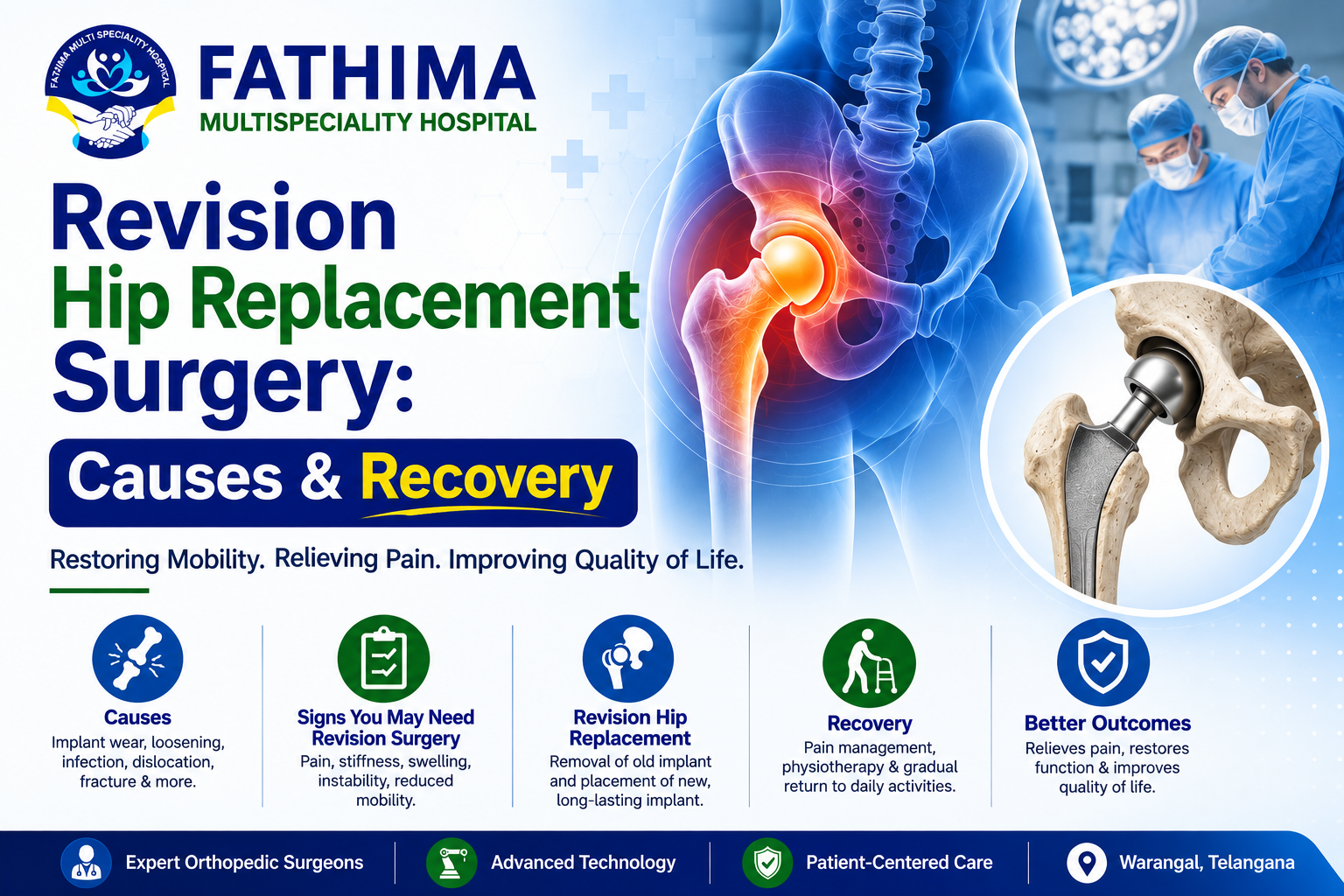
Revision Hip Replacement Surgery: Causes & Recovery
Discover the best foods for stronger bones and healthier joints, plus what to avoid. Expert diet guide from Fathima Multispeciality Hospital, Warangal.
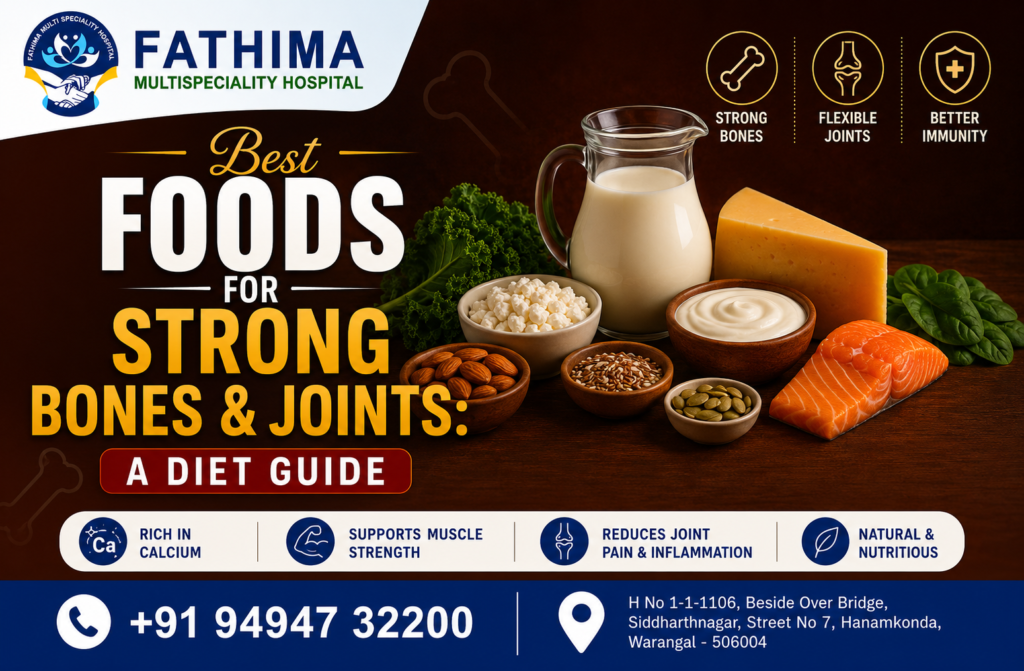
Walking, bending, climbing stairs, lifting your grandchild — the freedom to move without pain is something most of us don’t think about until it’s gone. That freedom rests on two things working well together: strong bones and healthy joints. And one of the most powerful tools you have to protect both isn’t a medicine — it’s your daily plate.
At Fathima Multispeciality Hospital, Warangal, our orthopaedic team believes prevention is as important as treatment. Alongside advanced care like robotic knee replacement for patients who need surgical correction, we want every patient to understand how everyday nutrition choices can delay or even prevent joint and bone problems in the first place.
Here’s a complete, practical guide to eating for stronger bones and more flexible joints.
Your skeleton is constantly rebuilding itself — a process called remodelling, where old bone is broken down and new bone is formed in its place. During your younger years, you build more bone than you lose, reaching what’s called Peak Bone Mass by around age 30. Think of it as a bone “savings account” — the more you build early, the more you have to draw on later, when natural bone loss speeds up with age.
Joints are cushioned by cartilage, a smooth tissue that stops bones from grinding against each other, and lubricated by synovial fluid for smooth movement. Chronic inflammation is one of the biggest threats to this system — it breaks down cartilage over time, leading to the stiffness and pain many people associate with “getting older.”
A well-planned diet won’t reverse either condition on its own, but it plays a real role in prevention and symptom management.
i. Calcium — The Building Block
About 99% of your body’s calcium is stored in your bones and teeth. Your body can’t produce calcium on its own — if your diet doesn’t supply enough, your body pulls it from your bones instead, gradually weakening them.
Good sources:
ii. Vitamin D — The Key That Unlocks Calcium
Without enough Vitamin D, your body can’t properly absorb the calcium you eat — no matter how calcium-rich your diet is.
How to get it:
iii. Magnesium, Vitamin K, and Protein — The Supporting Cast
Lorem ipsum dolor sit amet, consectetur adipiscing elit. Ut elit tellus, luctus n
i. Omega-3 Fatty Acids — A Natural Anti-Inflammatory
Omega-3s help reduce the body’s production of inflammatory chemicals, easing joint swelling and stiffness over time.
Best sources: Salmon, mackerel, sardines, tuna (aim for 2 servings/week); walnuts, flaxseeds, chia seeds for plant-based options.
ii. Antioxidants — Defending Against Joint Wear
iii. Turmeric and Ginger — Time-Tested Anti-Inflammatories
Turmeric contains curcumin, which may improve joint comfort — pair it with black pepper and a healthy fat to boost absorption. Ginger’s active compounds (gingerols) also help reduce joint inflammation.
ec ullamcorper mattis, pulvinar dapibus leo.
i. Excess Sugar
Added sugar can trigger inflammatory responses that worsen arthritis symptoms, and increases how much calcium your body excretes through urine. Watch for hidden sugars in sodas, sauces, and packaged foods.
ii. Excess Salt
High sodium intake, mostly from processed and packaged foods rather than table salt, can accelerate calcium loss over time.
iii. Unhealthy Fats
Saturated and trans fats (red meat, fried food, commercial baked goods) can trigger inflammation. An imbalance of omega-6 to omega-3 fats — common in diets heavy on processed food — can also promote a pro-inflammatory state.
iv. A Note on “Healthy” Foods That Block Absorption
Spinach is rich in oxalates, and beans/whole wheat bran contain phytates — both can bind to calcium and reduce absorption. This doesn’t mean avoiding them (they’re nutrient-dense in other ways) — just don’t rely on them as your main calcium source.
i. The Mediterranean Diet Pattern
Widely regarded as one of the best eating patterns for bone and joint health — rich in fruits, vegetables, whole grains, legumes, nuts, and olive oil, with moderate fish/poultry and limited red meat. Its natural anti-inflammatory profile has been linked to lower fracture risk and improved arthritis symptoms.
ii. A Sample Day of Bone-Friendly Eating
iii. Don’t Forget Movement
Diet builds the raw material — exercise tells your body to use it.
Nutrition is powerful, but it doesn’t replace medical evaluation. If you’re dealing with persistent joint pain, a family history of osteoporosis, or ongoing mobility concerns, it’s time to speak to an orthopaedic specialist.
At Fathima Multispeciality Hospital, our orthopaedic team — led by Dr. Sukesh Reddy P (MS Orthopaedics) — provides thorough evaluation and personalised care plans, from lifestyle and physiotherapy guidance to advanced procedures like robotic knee replacement when surgery is the right path forward.
Frequently Asked Questions (FAQ’s)
1Q: How much calcium do I need daily?
Ans: Most adults need around 1,000 mg per day, rising to 1,200 mg for women over 50 and men over 70. Your orthopaedic doctor can advise based on your specific health history.
2Q: What’s the best diet for joint pain specifically?
Ans: An anti-inflammatory eating pattern — similar to the Mediterranean diet, rich in omega-3s, antioxidants, and low in processed sugar — tends to help most with joint-related discomfort.
H No 1-1-1106, Beside Over Bridge Sidharthnagar, Street No 7, Hanamkonda, Telangana - 506004