
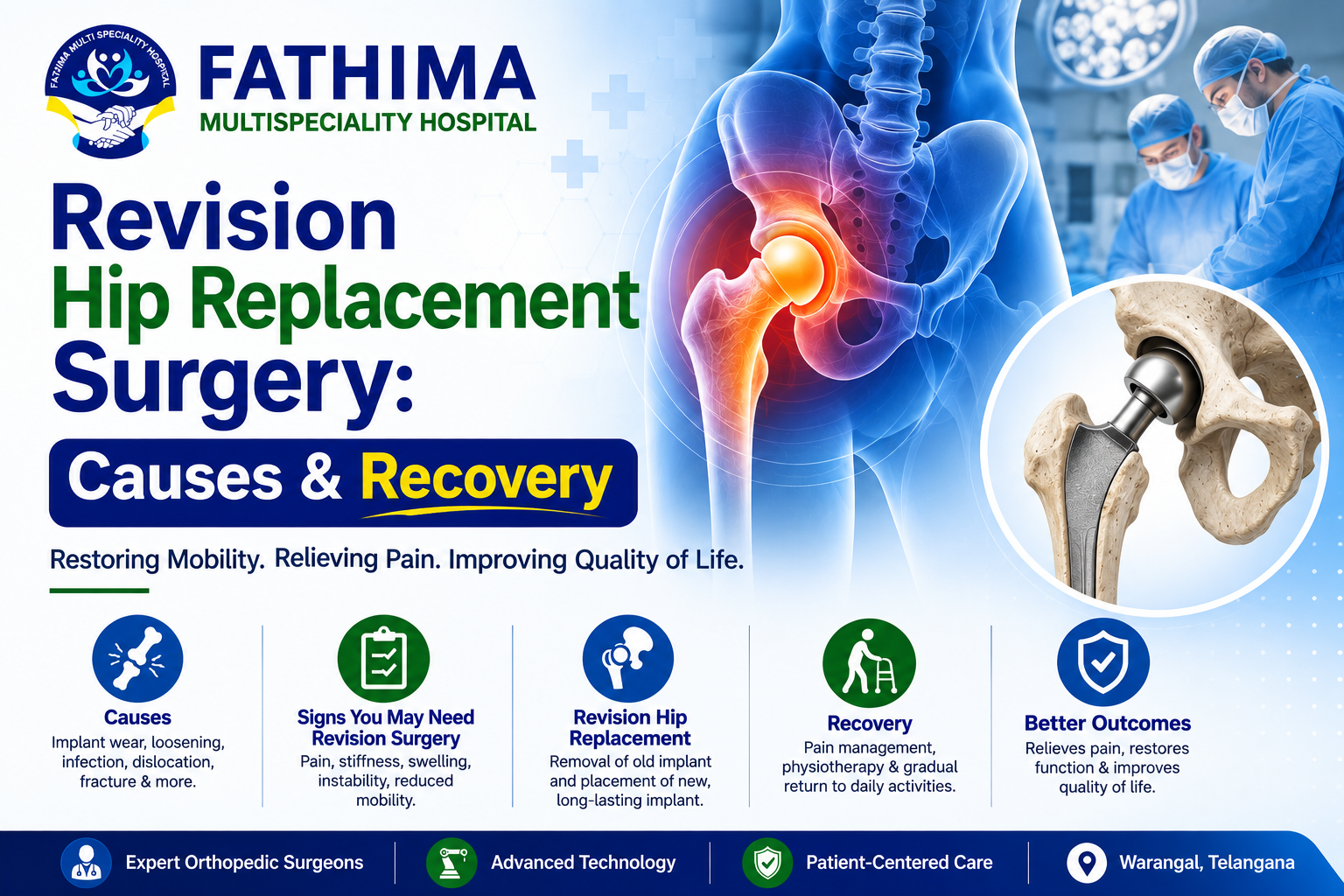
Revision Hip Replacement Surgery: Causes & Recovery
Sprain or strain? Learn the key differences, causes, symptoms & treatment options from Fathima Multispeciality Hospital’s orthopaedic experts in Warangal.
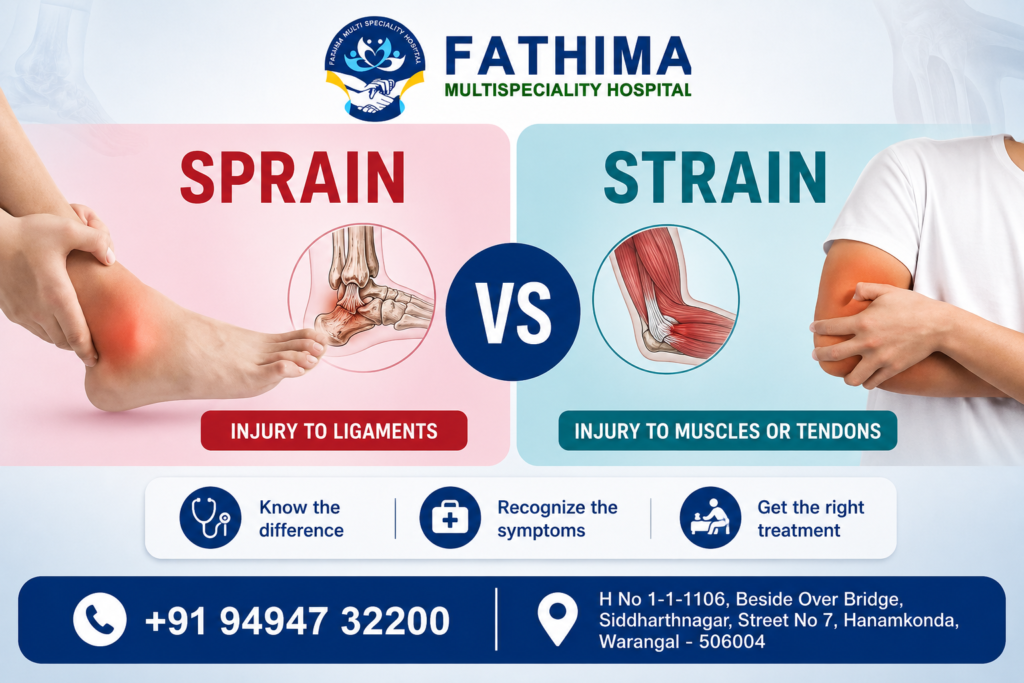
Did you twist your ankle getting off a bike or feel a stinging tug in your lower back while moving something heavy?Most people call both a “sprain” — but medically, they’re two different injuries affecting different parts of the body.
At Fathima Multispeciality Hospital, Warangal, our orthopaedic team sees both injuries every week, from sports mishaps to everyday household accidents. Knowing the difference matters — because a sprain and a strain don’t heal the same way, and treating one like the other can slow down your recovery.
Here’s a clear breakdown of what separates the two, so you know exactly what you’re dealing with and when it’s time to see a specialist.
An injury to a muscle or tendon—the tissue that joins muscle to bone—is referred to as a strain. Ligaments keep your joints stable and stop them from moving too far in the wrong direction. When a joint is forced beyond its normal range, the ligament stretches or tears.
Sprains most commonly affect the ankles, wrists, and knees — joints that take the brunt of sudden twists, falls, and awkward landings.
Common Causes of a Sprain
Symptoms of a Sprain
A strain is a damage to a muscle or tendon, which connects muscle to bone.Unlike a sprain, which affects the joint itself, a strain affects the soft tissue that moves the joint.
Strains are most common in the lower back, hamstrings, and shoulders — areas that bear repeated stress during lifting, running, and everyday movement.
Common Causes of a Strain
Symptoms of a Strain
Feature | Sprain | Strain |
What’s injured | Ligaments (connect bone to bone) | Muscles or tendons (connect muscle to bone) |
Common causes | Twisting, falls, awkward landings | Overuse, heavy lifting, sudden overstretching |
Key symptoms | Pain, swelling, bruising, joint instability | Pain, swelling, muscle spasms, weakness |
First-line treatment | Rest, ice, compression, elevation (RICE); severe cases may need surgery | Rest, ice, compression, gentle stretching, rehab |
i. Severity matters more than the label. A mild strain can heal faster than a severe sprain, and vice versa. What determines your treatment and recovery timeline isn’t the name of the injury — it’s how badly the tissue is damaged.
ii. Ignoring a “minor” sprain or strain can cause long-term problems.
iii. Misdiagnosis leads to the wrong treatment. Resting a strain completely may seem safe, but many strains need gentle, gradual movement to heal properly — while sprains often need more support and temporary immobilisation. Getting the diagnosis right from the start makes a real difference.
How Fathima Multispeciality Hospital Treats Sprains and Strains
For a Sprain
For a Strain
Our orthopaedic team, led by Dr. Sukesh Reddy P (MS Orthopaedics), uses advanced diagnostics to accurately identify the extent of ligament or muscle damage — so you get the right treatment the first time, not a guess.
Lorem ipsum dolor sit amet, consectetur adipiscing e
See a doctor if you notice:
Whether it’s a sprain, a strain, or something more serious, don’t leave it to guesswork. Fathima Multispeciality Hospital — home to Warangal’s advanced orthopaedic and robotic knee care unit — is here to diagnose it right and get you moving again.
Book an Appointment or call +91 94947 32200 to consult our orthopaedic specialists today.
Frequently Asked Questions (FAQ’s)
1Q: Can a sprain and a strain happen at the same time?
Ans: Yes — a hard fall or twisting injury can damage both a ligament and a nearby muscle or tendon at once. This is common enough that it’s worth getting properly examined rather than self-diagnosing.
2Q: How long does it take to recover from a sprain or strain?
Ans: Mild cases often improve in 1–3 weeks with RICE care. Moderate to severe injuries can take 6–8 weeks or longer, especially if physiotherapy or surgery is needed.
H No 1-1-1106, Beside Over Bridge Sidharthnagar, Street No 7, Hanamkonda, Telangana - 506004