
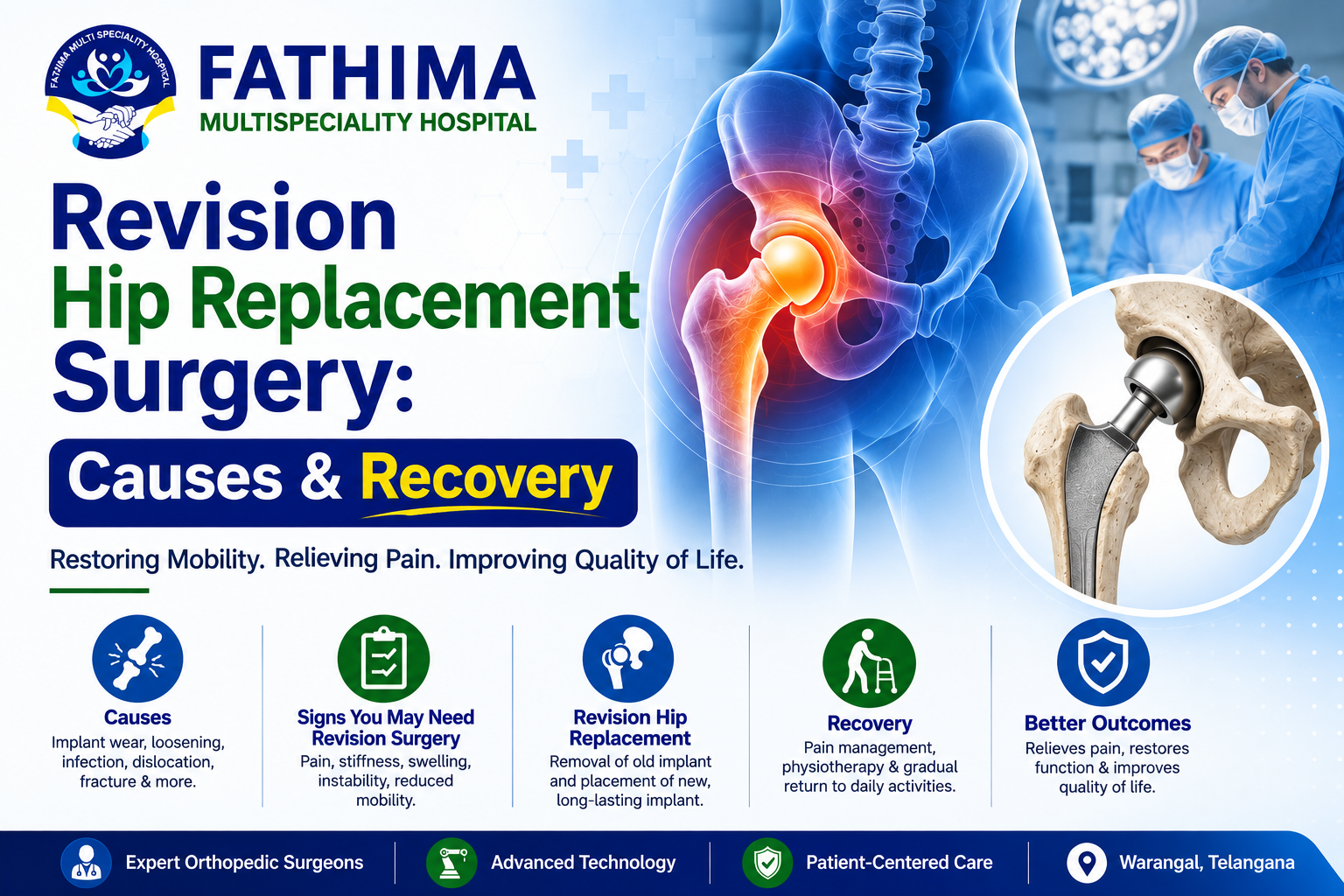
Revision Hip Replacement Surgery: Causes & Recovery
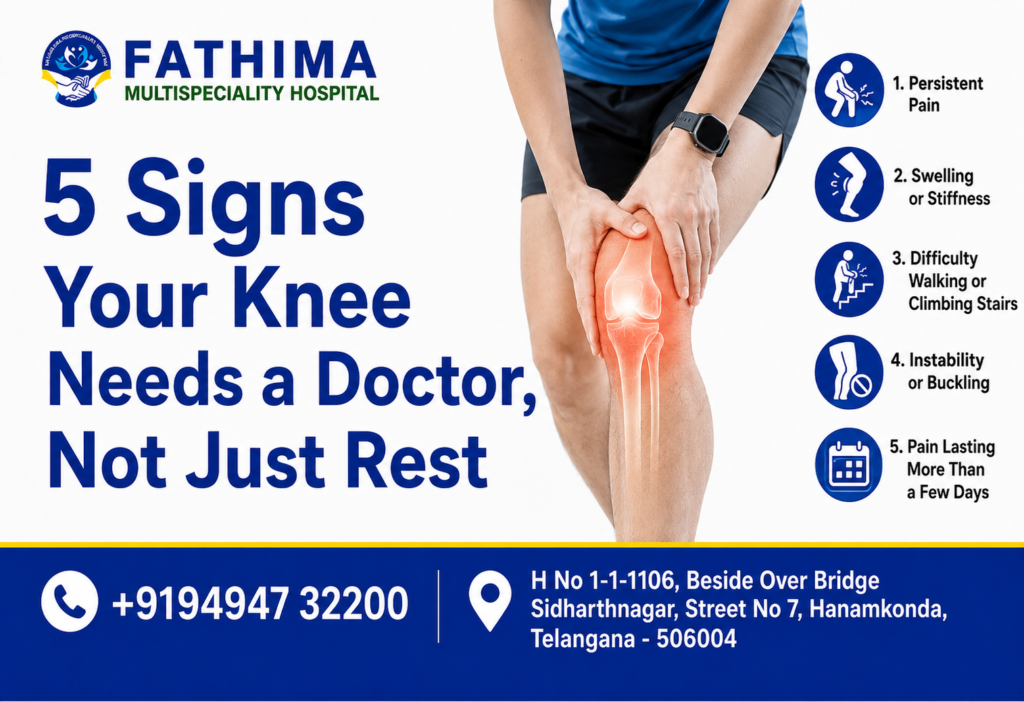
Most of us have been there — a little knee pain after a long walk, a twinge climbing stairs, or stiffness after sitting too long. We think: “I’ll rest for a day or two, it’ll sort itself out.” Sometimes it does. But sometimes, waiting is the worst thing you can do.
At Fathima Multispeciality Hospital, our orthopedic expert Dr. Sukesh Reddy P sees patients every week who delayed treatment for weeks — even months — hoping rest alone would heal the problem. The result? What started as a minor issue had become a complex injury requiring intensive care.
Here are 5 warning signs your knee is sending you that demand medical attention — not just a hot pack and a day off.
Minor swelling after a strain is normal. Your body is sending fluid to repair tissue. But if your knee looks puffy, feels tight, or remains visibly swollen for more than two to three days — that’s your body signalling something more serious.
Persistent swelling can indicate a torn ligament (like the ACL or MCL), a meniscus tear, fluid accumulation from infection, or early-stage arthritis. Ignoring this allows damage to worsen and the joint to degrade faster.
What to do: If swelling doesn’t reduce with elevation and ice within 48–72 hours, book an evaluation with an orthopaedic specialist immediately.
Minor swelling after a strain is normal. Your body is sending fluid to repair tissue. But if your knee looks puffy, feels tight, or remains visibly swollen for more than two to three days — that’s your body signalling something more serious.
Persistent swelling can indicate a torn ligament (like the ACL or MCL), a meniscus tear, fluid accumulation from infection, or early-stage arthritis. Ignoring this allows damage to worsen and the joint to degrade faster.
What to do: If swelling doesn’t reduce with elevation and ice within 48–72 hours, book an evaluation with an orthopaedic specialist immediately.
Pain is your body’s alarm system. Occasional soreness after exercise is expected. But pain that wakes you from sleep, pain that is present even when you’re resting, or discomfort that continues for more than two weeks without any improvement — these are not “normal” signs of aging or overuse.
Night pain in particular is associated with inflammatory arthritis, bone stress injuries, and in rare cases, serious conditions like bone tumours. Chronic pain lasting over two weeks typically means the tissue isn’t healing without intervention.
What to do: Document when the pain occurs, its intensity (1–10 scale), and triggers. Share this with your doctor — this history is critical for accurate diagnosis.
A healthy knee looks symmetrical and feels cool to the touch. If your knee appears visibly misshapen, one side looks higher or lower than usual, the skin over the joint feels hot, or the area is red and inflamed — these are urgent warning signs.
Redness and warmth can indicate septic arthritis (a joint infection requiring immediate antibiotics or drainage), acute gout flare-up, or a severe ligament or bone injury. A visible deformity after trauma almost certainly signals a fracture or dislocation — treat this as a medical emergency.
What to do: Redness + warmth + swelling = go to the hospital the same day. Do not apply pressure or try to “pop it back” yourself.
A healthy knee looks symmetrical and feels cool to the touch. If your knee appears visibly misshapen, one side looks higher or lower than usual, the skin over the joint feels hot, or the area is red and inflamed — these are urgent warning signs.
Redness and warmth can indicate septic arthritis (a joint infection requiring immediate antibiotics or drainage), acute gout flare-up, or a severe ligament or bone injury. A visible deformity after trauma almost certainly signals a fracture or dislocation — treat this as a medical emergency.
What to do: Redness + warmth + swelling = go to the hospital the same day. Do not apply pressure or try to “pop it back” yourself.
Book an Appointment Visit: Fathima Multispeciality Hospital
1Q: When should I see a doctor for knee pain instead of resting at home?
Ans: You should see a doctor if your knee pain lasts more than two weeks, comes with swelling, locking, or causes you to change how you walk. Resting at home is fine for minor soreness, but these signs mean the joint needs professional evaluation. Dr. Sukesh Reddy P at Fathima Multispeciality Hospital recommends early diagnosis to prevent minor injuries from becoming major ones.
2Q: Where can I get expert knee pain treatment in Warangal?
Ans: For trusted knee pain diagnosis and orthopaedic care, consult Dr. Sukesh Reddy P at Fathima Multispeciality Hospital. The hospital offers advanced orthopaedic evaluation, MRI-based diagnosis, and both surgical and non-surgical treatment options — all under one roof.
H No 1-1-1106, Beside Over Bridge Sidharthnagar, Street No 7, Hanamkonda, Telangana - 506004