
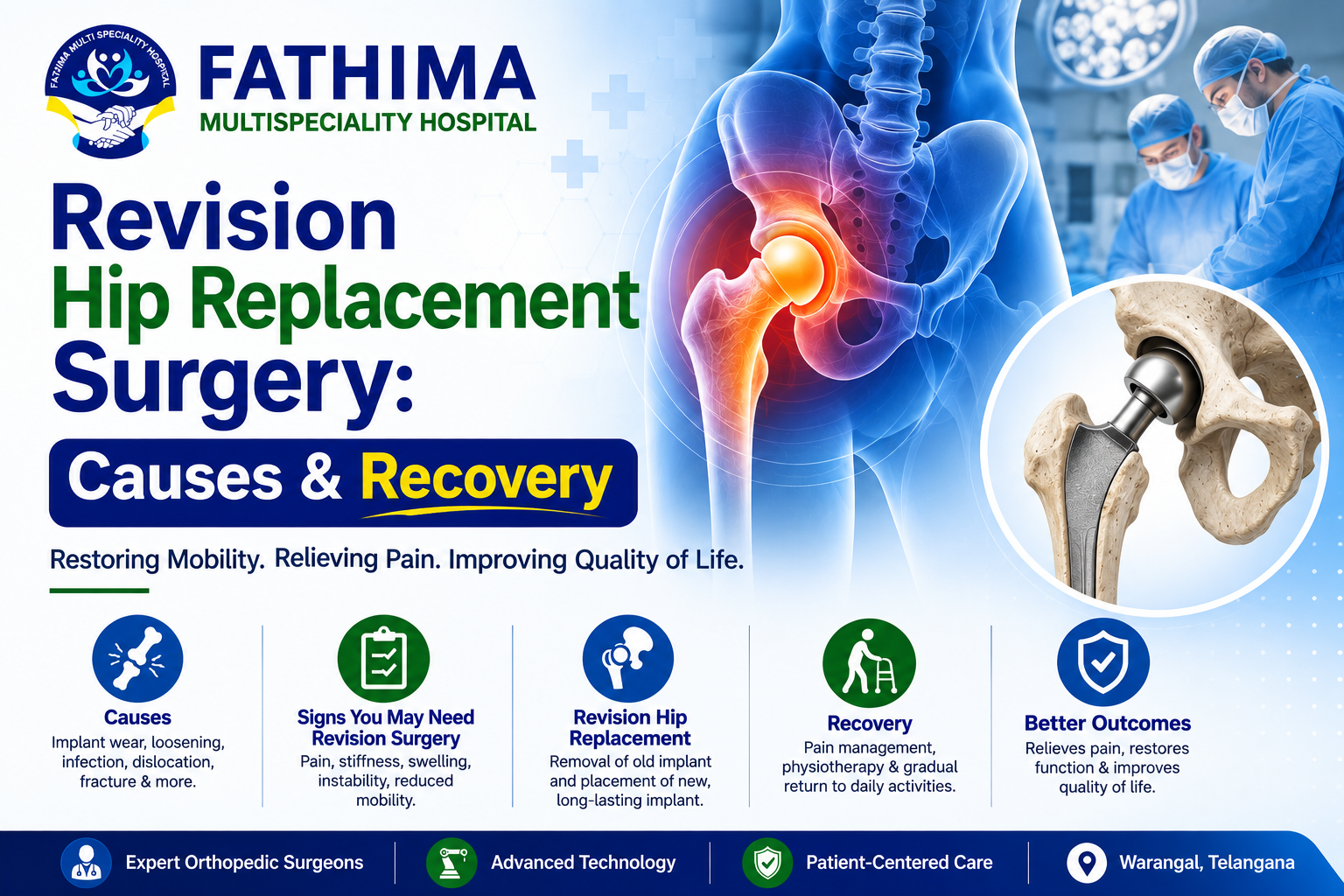
Revision Hip Replacement Surgery: Causes & Recovery

Your bones are the silent foundation of everything you do — from walking to the kitchen in the morning to carrying your child to bed at night. Yet most of us only think about our bones when something goes wrong: a fracture, a sudden pain, or a diagnosis like osteoporosis that feels like it came out of nowhere.
The truth is, bone health is built over a lifetime — and destroyed faster than most people realize. At Fathima Multispeciality Hospital, our orthopaedic team led by Dr. Sukesh Reddy P (MS Orthopaedics) sees hundreds of patients every year who could have prevented their bone problems with simple, consistent habits.
The human body contains 206 bones. They do far more than hold us upright — they protect vital organs, anchor our muscles, store essential minerals like calcium and phosphorus, and produce blood cells in the bone marrow.
What surprises most patients is this: bones are living tissue. They are constantly being broken down and rebuilt in a process called remodeling. In your 20s and 30s, your body builds bone faster than it breaks it down. But after your 30s — and especially after menopause in women — this process reverses. Bone loss gradually outpaces bone formation.
This is why starting early matters. And it’s also why — no matter your age — it’s never too late to take action.
Calcium is the most important mineral for bone strength. Adults generally need 1,000 mg of calcium per day, rising to 1,200 mg for women over 50 and men over 70.
Best calcium-rich foods include:
One glass of milk contains around 300 mg of calcium. Ragi is one of the richest plant-based sources available in India, with nearly 344 mg of calcium per 100 grams — making it a superfood for your bones.
ii. Don’t Ignore Vitamin D
Even if you eat enough calcium, your body cannot absorb it without adequate Vitamin D. This is one of the most widespread and under-diagnosed deficiencies in India — particularly among urban populations who spend most of their time indoors.
How to get Vitamin D:
Vitamin D deficiency leads not only to weak bones (osteomalacia in adults, rickets in children) but also to general fatigue, muscle weakness, and increased fracture risk.
III. Exercise Regularly — Focus on Weight-Bearing Activities
Physical activity is one of the most powerful things you can do for your bones. Exercise stimulates bone formation by placing mechanical stress on the skeleton, signaling the body to build more bone tissue.
Best bone-strengthening exercises:
Aim for at least 30 minutes of weight-bearing exercise, 5 days a week. Even brisk walking around your neighborhood makes a significant difference over time.
iv. Eat a Balanced, Bone-Friendly Diet
Beyond calcium and Vitamin D, several other nutrients play critical roles in bone health:
A diet rich in vegetables, fruits, legumes, and whole grains — essentially a traditional Indian diet when done well — provides most of what your bones need.
v. Quit Smoking and Limit Alcohol
Both smoking and excessive alcohol consumption are major risk factors for bone loss and fractures.
Smoking reduces bone density by interfering with the body’s ability to absorb calcium and by reducing estrogen levels in women — estrogen is a key hormone that protects bone. Smokers are also significantly more likely to sustain hip fractures.
Alcohol interferes with the balance of calcium and Vitamin D in the body, slows bone formation, and increases the risk of falls due to impaired coordination.
Quitting smoking and limiting alcohol to no more than one drink per day for women and two for men can meaningfully slow bone loss and reduce fracture risk.
vi. Maintain a Healthy Body Weight
Both underweight and overweight extremes can harm your bones.
Being underweight means less mechanical load on the skeleton (reducing the signal to build bone) and often correlates with nutritional deficiencies. Women with very low body weight are at especially high risk for osteoporosis.
Being overweight places excessive stress on weight-bearing joints and bones, accelerating wear and increasing the risk of fractures from falls.
A healthy BMI — approximately 18.5 to 24.9 — combined with good nutrition and exercise gives your bones the best environment to stay strong.
VII. Watch Your Salt, Caffeine, and Soft Drink Intake
Certain dietary habits can quietly deplete your calcium levels:
These are not reasons to eliminate these entirely, but to consume them in moderation — especially if your calcium intake is already borderline.
VIII. Get Your Bone Density Checked (DEXA Scan)
Many people with osteoporosis have no symptoms at all until they suffer a fracture — often from something as minor as a small slip or even a cough. This is why screening matters.
A DEXA (Dual-Energy X-ray Absorptiometry) scan measures bone mineral density and can detect osteopenia (early bone loss) or osteoporosis before any fractures occur.
Who should get screened:
At Fathima Multispeciality Hospital, Dr. Sukesh Reddy P (MS Orthopaedics) recommends proactive bone density evaluation — especially for postmenopausal women and anyone over 50 with joint or back pain.
ix. Be Careful with Medications That Affect Bone Health
Several commonly prescribed medications can reduce bone density over time when used long-term:
If you are on any of these long-term, discuss bone health monitoring with your doctor. You may need supplemental calcium, Vitamin D, or even bone-protective medications.
x. Prevent Falls — Especially as You Age
Strong bones are only half the equation. The other half is not breaking them. Falls are the leading cause of fractures in adults over 50, and many fall-related fractures — especially hip fractures — can be life-altering.
Practical fall-prevention tips:
i. For Women
Women are at significantly higher risk for osteoporosis due to lower peak bone mass and the dramatic drop in estrogen during menopause. Bone loss accelerates in the first 5–10 years after menopause. If you are approaching or past menopause, a proactive conversation with your doctor about hormone levels and bone density is essential.
ii. For Children and Teenagers
Peak bone mass is reached in your late 20s. Up to 90% of peak bone mass is built by age 18 in girls and age 20 in boys. This makes childhood and adolescence the most critical window for bone investment. Adequate calcium, Vitamin D, physical activity, and avoiding smoking are crucial during these years.
III. For Older Adults
As we age, the risk of fractures, especially of the hip, spine, and wrist, increases significantly. For older adults, the focus shifts from building bone to preserving it, preventing falls, and maintaining strength and balance.
You should consult an orthopaedic doctor if you experience:
Early evaluation can catch bone loss before it becomes a fracture — and treatment options today are more effective than ever.
At Fathima Multispeciality Hospital, we believe that great bone health is built through education, early screening, and expert medical guidance. Our orthopaedic department, led by Dr. Sukesh Reddy P (MS Orthopaedics), offers comprehensive bone and joint care — from bone density evaluation and nutritional counseling to advanced fracture management and joint replacement surgery.
Whether you are a young adult looking to build strong bones for life, or a senior managing bone loss, our team is here to guide you every step of the way.
Frequently Asked Questions (FAQ’s)
1Q: What are the best foods for strong bones?
Ans: Calcium-rich foods like milk, ragi, paneer, leafy greens, almonds, and fish help improve bone strength naturally.
2Q: When should I get a bone density (DEXA) scan?
Ans: Adults above 50, especially women after menopause, should consider a DEXA scan to detect early bone loss and prevent fractures.
H No 1-1-1106, Beside Over Bridge Sidharthnagar, Street No 7, Hanamkonda, Telangana - 506004