
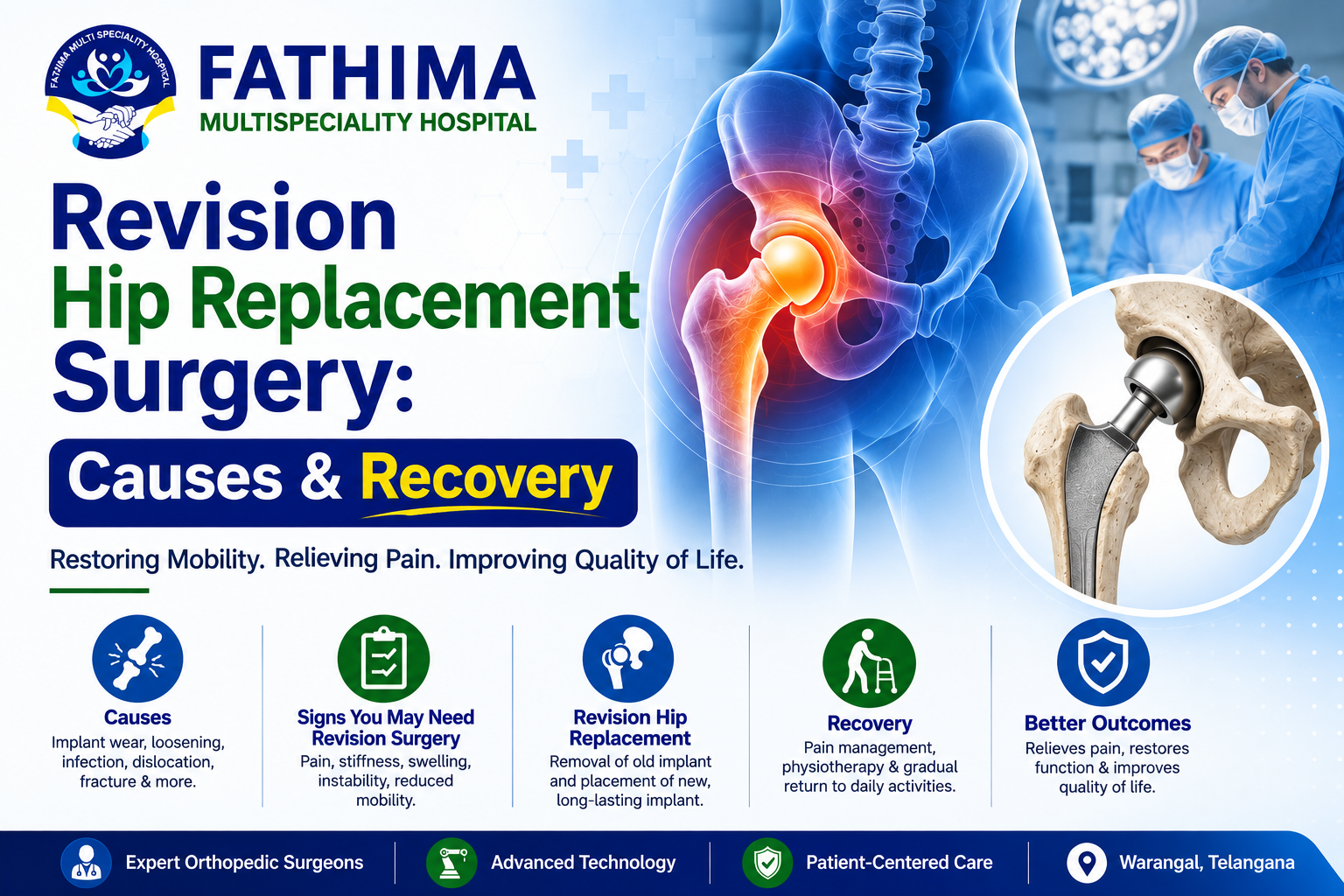
Revision Hip Replacement Surgery: Causes & Recovery
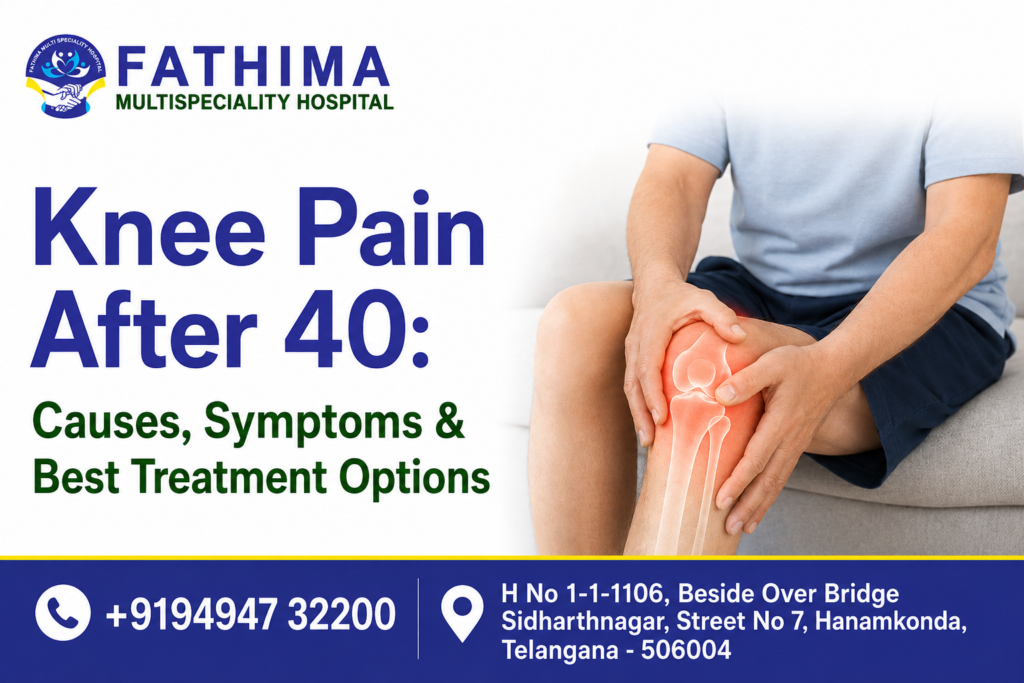
That twinge when you climb the stairs. The stiffness when you stand up after sitting too long. The dull ache that settles in at the end of a long day. Sound familiar?
If you are in your 40s or beyond and your knees have started speaking to you — you need to listen. Not because knee pain after 40 is a crisis, but because what you do with that signal right now will determine how freely you move for the next 20, 30, or 40 years of your life.
At Fathima Multispeciality Hospital, this is a conversation Dr. Sukesh Reddy P (MS Orthopaedics) has with patients every single day. And the message is always the same: knee pain is not a sentence. It is a warning — and warnings exist to be acted on.
This guide will walk you through everything you need to understand about knee pain after 40 — what is causing it, what it means, and most importantly, what you can do about it.
Think about this: your knees bear the full weight of your body with every single step. Over 40 years, that adds up to millions of loading cycles. It is not surprising that things begin to shift.
But age alone is not the villain. Several specific changes combine to make the knee more vulnerable after 40:
The cartilage loses its resilience. Cartilage is the smooth, slippery tissue that lines the ends of your knee bones and allows them to glide effortlessly. Unlike muscle or skin, cartilage cannot regenerate easily. Over time, it thins, softens, and cracks — and once it is gone, it is very difficult to replace.
The supporting muscles weaken. The quadriceps at the front of your thigh and the hamstrings at the back are your knee’s natural shock absorbers. When these muscles weaken — as they do with age and reduced activity — the joint itself takes on more stress than it was designed to handle.
Hormones play a bigger role than most people realise. In women especially, the drop in estrogen levels around perimenopause directly weakens cartilage, tendons, and ligaments. This is why women are nearly twice as likely as men to develop knee osteoarthritis.
Body weight compounds everything. Research consistently shows that every extra kilogram of body weight places roughly 4 kilograms of additional force on the knee joint. Even modest weight gain over the years quietly accelerates joint wear.
Old injuries resurface. That ankle sprain from your cricket days in your 20s, the knee knock from a fall you shrugged off — the body has a long memory. Past injuries often become present problems after 40.
Understanding these factors is the first step. Because most of them are manageable — if you start now.
Knee pain is a symptom, not a diagnosis. The treatment depends entirely on what is behind the pain — and there are several distinct conditions that commonly affect people over 40.
Osteoarthritis (OA) is the gradual wearing away of cartilage inside the knee joint. As cartilage breaks down, the space between the bones narrows, friction increases, and inflammation sets in. In advanced stages, bone rubs directly against bone.
It is the leading cause of knee pain in India among adults over 40 — and it is dramatically underdiagnosed because many people assume the pain is “just normal ageing.”
How it feels:
OA progresses in stages. Catching it early — before bone damage sets in — opens up a wide range of non-surgical treatment options.
Between the bones of your knee sit two C-shaped cartilage pads called menisci. They act as shock absorbers and stabilisers. In younger people, meniscus tears usually result from sudden trauma — a twist, a tackle, a fall. But after 40, the menisci become brittle, and tears can happen from surprisingly ordinary movements: standing up from a low chair, stepping off a kerb, or turning quickly while walking.
How it feels:
The kneecap (patella) sits in a groove at the front of the knee and glides up and down as you bend and straighten your leg. When this tracking goes slightly off — due to muscle imbalances, overuse, or natural wear — the result is pain around and behind the kneecap.
How it feels:
Bursae are small, fluid-filled sacs that reduce friction around the knee. Repeated pressure — from kneeling, prolonged squatting, or direct impact — can inflame them, causing localised swelling and pain.
This is particularly common in people whose daily routines involve a lot of kneeling: those who pray in a kneeling position, domestic workers, gardeners, and certain tradespeople.
How it feels:
Gout is caused by a build-up of uric acid crystals in the joint, triggering sudden, severe episodes of pain, redness, and swelling. Most people know gout as a big-toe condition, but it strikes the knee more often than most people realise — particularly in men over 40 who consume a diet high in red meat, seafood, or alcohol.
How it feels:
The iliotibial band is a tough strip of connective tissue that runs from the hip down to just below the outer knee. When it becomes tight or irritated — often from walking long distances, hiking, or cycling — it produces a sharp, burning pain on the outer side of the knee that worsens with continued activity.
The four main ligaments of the knee — ACL, PCL, MCL, and LCL — keep the joint stable. With age, these ligaments lose some elasticity and become more susceptible to partial tears and chronic looseness, particularly in physically active individuals or those with old knee injuries.
The result is a knee that feels unstable — like it might buckle or give way unexpectedly — often accompanied by pain and swelling.
Many forms of knee discomfort can safely be monitored for a short period. But these warning signs require you to see a doctor promptly — do not wait:
Dr. Sukesh Reddy P at Fathima Multispeciality Hospital strongly advises against self-medicating with painkillers beyond the first few days. Masking pain without treating its cause is one of the most common reasons patients arrive with advanced joint damage that could have been avoided.
Arriving at the right diagnosis requires more than just an X-ray. When you consult Dr. Sukesh Reddy P, the evaluation includes:
A detailed history: When did the pain start? What makes it worse or better? Is there morning stiffness? Any history of injury? These details guide everything that follows.
Clinical examination: Assessment of knee alignment, swelling, range of motion, tenderness, stability, and muscle strength. Specific clinical tests can identify meniscal tears, ligament laxity, and patellofemoral dysfunction within the examination itself.
Investigations when needed:
The combination of clinical skill and appropriate investigation ensures that treatment targets the actual problem — not just the pain.
Here is the reassuring truth: most knee pain conditions in adults over 40 respond well to non-surgical treatment. Surgery is reserved for situations where conservative measures have been exhausted or where structural damage demands it.
Physiotherapy The single most effective non-surgical treatment for knee pain. A well-designed physiotherapy programme strengthens the quadriceps, hamstrings, and hip muscles — taking mechanical load off the joint. It also improves balance, coordination, and gait, all of which reduce re-injury risk.
Weight loss Even a 5–7% reduction in body weight produces a measurable reduction in knee pain and improves function in arthritic patients. Combined with physiotherapy, weight management delivers results that many patients are surprised by.
Medications Anti-inflammatory medications (NSAIDs) provide short-term relief during flare-ups. Topical gels are a safer option for those who cannot tolerate oral tablets. Gout requires specific medication to lower uric acid levels and prevent future attacks.
Joint injections
Knee bracing and orthotics A well-fitted unloader brace can shift weight away from the damaged compartment of the knee, significantly reducing pain during activity. Custom foot orthotics correct alignment issues that contribute to abnormal knee loading.
Arthroscopy A keyhole procedure performed under anaesthesia. A thin camera is inserted into the knee through tiny incisions to both diagnose and treat problems — including meniscal tears, cartilage damage, and loose fragments inside the joint. Recovery is rapid compared to open surgery.
High Tibial Osteotomy (HTO) Recommended for younger patients with knee osteoarthritis confined to one compartment. The procedure realigns the knee so that body weight is redistributed away from the worn area. It can delay knee replacement surgery by a decade or more in suitable candidates.
Partial Knee Replacement When only one compartment of the knee is severely arthritic, a partial replacement preserves the healthy portions of the joint while resurfacing the damaged area. Less invasive than total replacement, with faster recovery.
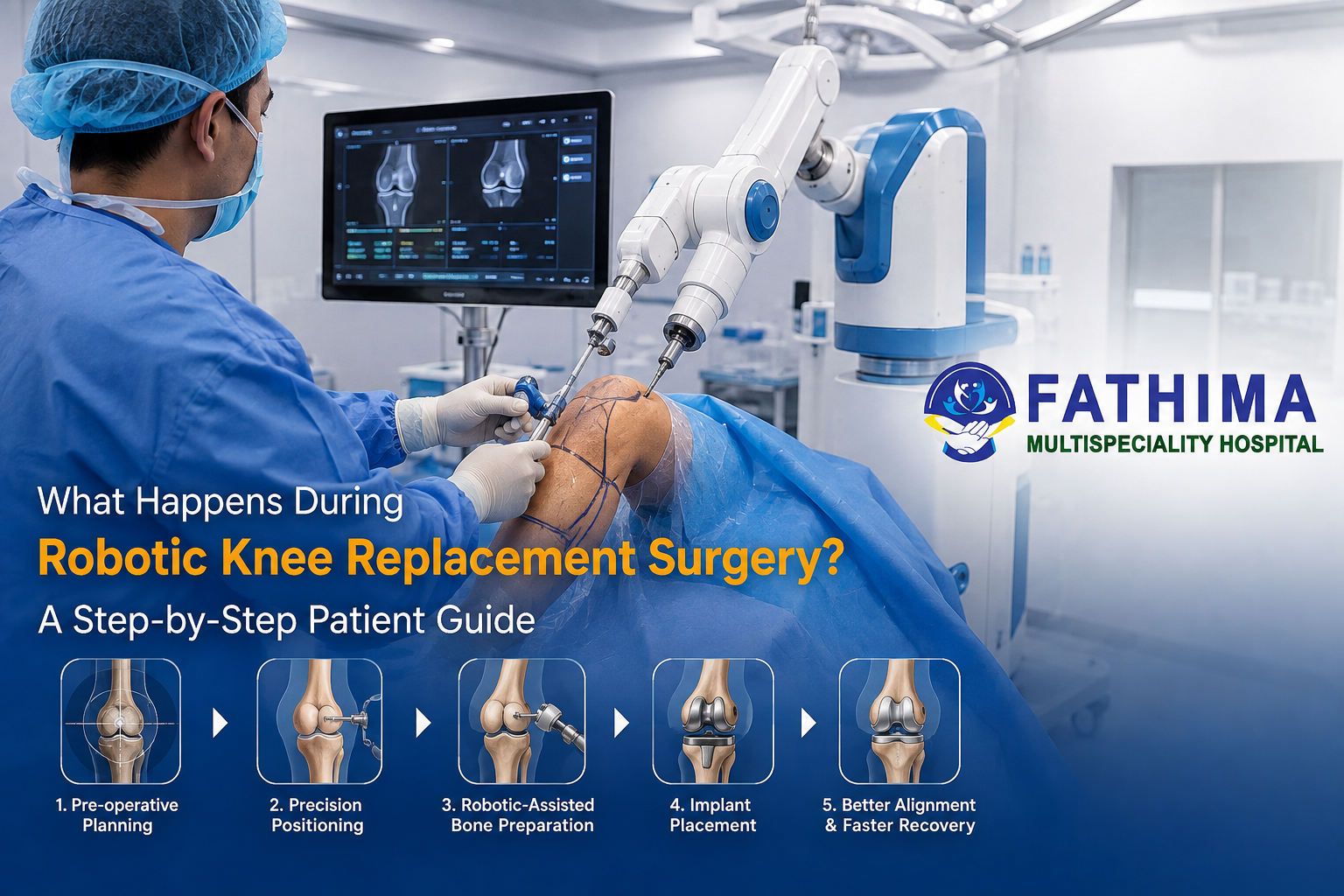
Total Knee Replacement The definitive treatment for end-stage knee osteoarthritis. The damaged surfaces of the knee are replaced with precision-engineered implants. Today’s implants are durable, long-lasting, and designed to replicate natural knee motion. Most patients return to comfortable daily activity within 4–6 weeks.
Dr. Sukesh Reddy P at Fathima Multispeciality Hospital performs the full spectrum of knee procedures — from arthroscopy to total knee replacement — using advanced implants and techniques that prioritise long-term outcomes and patient safety.
You do not need to overhaul your life. Small, consistent changes make a profound long-term difference.
Choose low-impact exercise. Walking on flat ground, swimming, cycling, and yoga build strength and cardiovascular fitness without battering the joint. These are not compromises — they are the smart choice for knee longevity.
Build your quadriceps. Strong thigh muscles are the best brace your knee has. Straight leg raises, wall sits, and step-ups are simple exercises you can do at home.
Lose even a little weight. You do not need to reach an ideal body weight. Losing 4–5 kg reliably reduces knee pain in most arthritic patients — and the effects are sustained as long as the weight stays off.
Upgrade your footwear. Replace worn-out soles, avoid flat slippers for extended use, and consider cushioned, supportive footwear for daily wear. Poor footwear is an underrated contributor to knee problems.
Always warm up. Five minutes of gentle movement before any physical activity prepares cartilage, lubricates the joint, and reduces injury risk significantly.
Break up long sitting periods. Every 30–45 minutes, stand up and walk a short distance. Prolonged static positioning leads to stiffness and reduced circulation to joint cartilage.
Drink enough water. Cartilage is approximately 75% water. Staying hydrated maintains the cushioning capacity of your knee cartilage — a simple, free intervention that most people underutilise.
Make your home knee-safe. Grab bars in the bathroom, stable handrails on stairs, non-slip mats, and good lighting all reduce the risk of falls — the most common cause of acute knee injury in adults over 50.
If any of the following apply to you, book a consultation at Fathima Multispeciality Hospital:
Early evaluation costs far less — in time, money, and quality of life — than treating advanced knee damage.
Knee pain after 40 is common, but it is not something to normalise and ignore. The causes range from cartilage wear and meniscal tears to gout and bursitis — and each requires a different treatment approach. The vast majority of conditions are very manageable, especially when addressed early. Non-surgical options including physiotherapy, weight loss, and joint injections work remarkably well. Surgery, when needed, delivers excellent outcomes with today’s techniques. And the habits you build now — exercise, weight management, good footwear, hydration — are the most powerful protection your knees have.
Your knees have carried you this far. With the right care, they will carry you much further.
Fathima Multispeciality Hospital Advanced Care. Compassionate Healing. Every Step of the Way.
Schedule your knee consultation with Dr. Sukesh Reddy P at Fathima Multispeciality Hospital — because your mobility is worth protecting.
H No 1-1-1106, Beside Over Bridge Sidharthnagar, Street No 7, Hanamkonda, Telangana - 506004