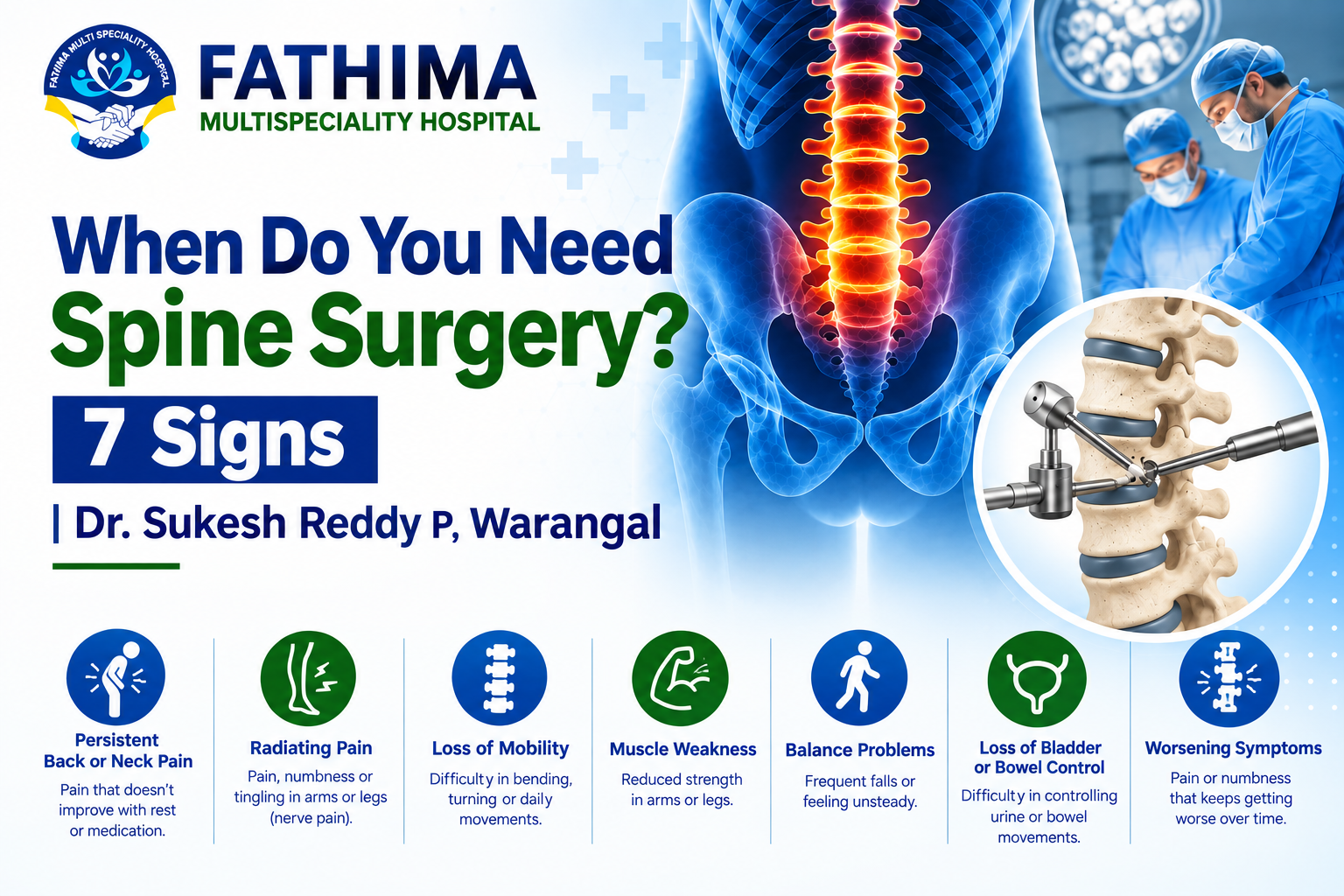
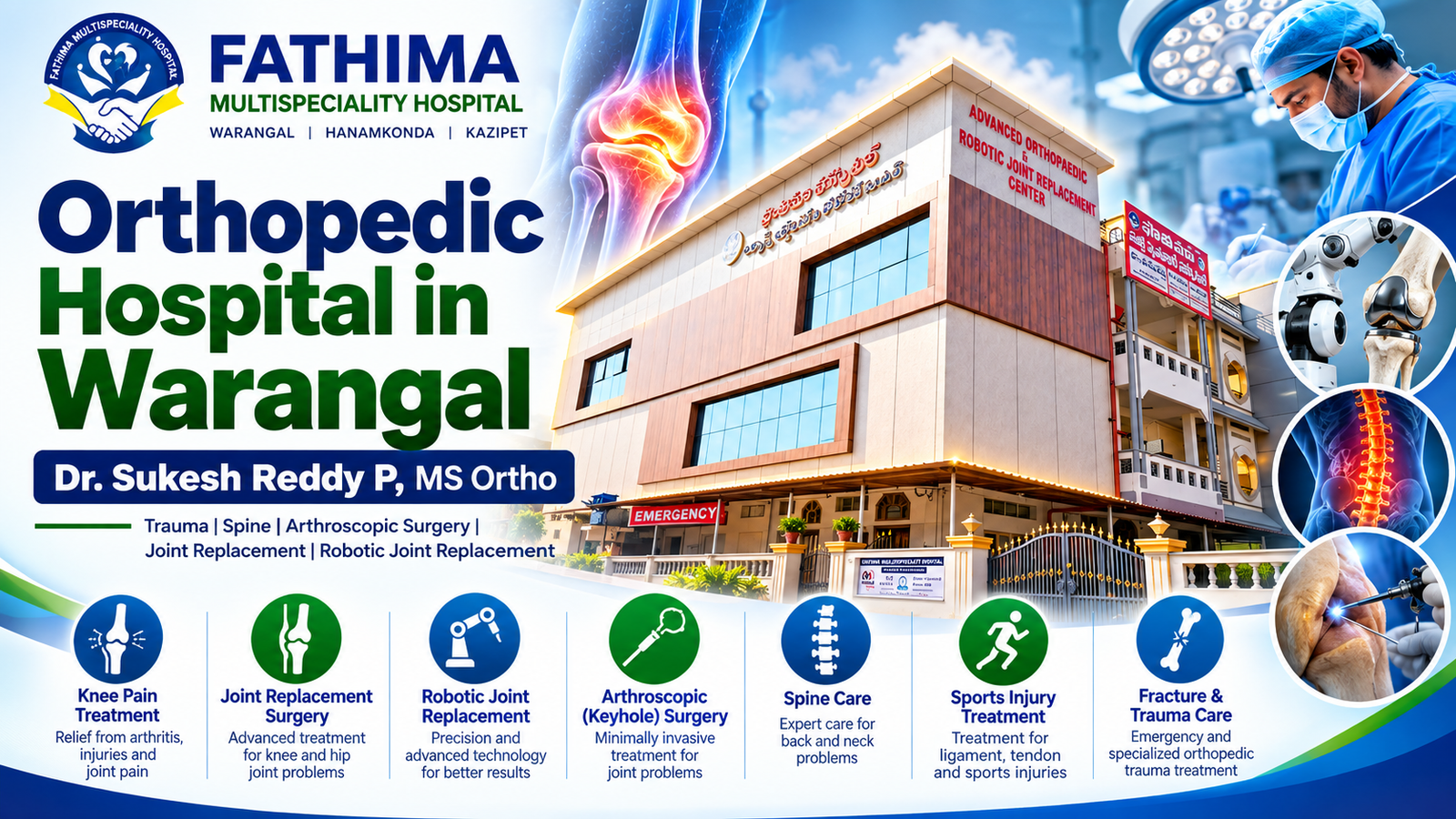
Orthopedic Hospital in Warangal | Dr. Sukesh Reddy P, MS Ortho
Back pain that won’t go away? Learn 7 signs you should see a spine surgeon, when surgery is really needed, and what to expect. Fathima Hospital, Hanamkonda.
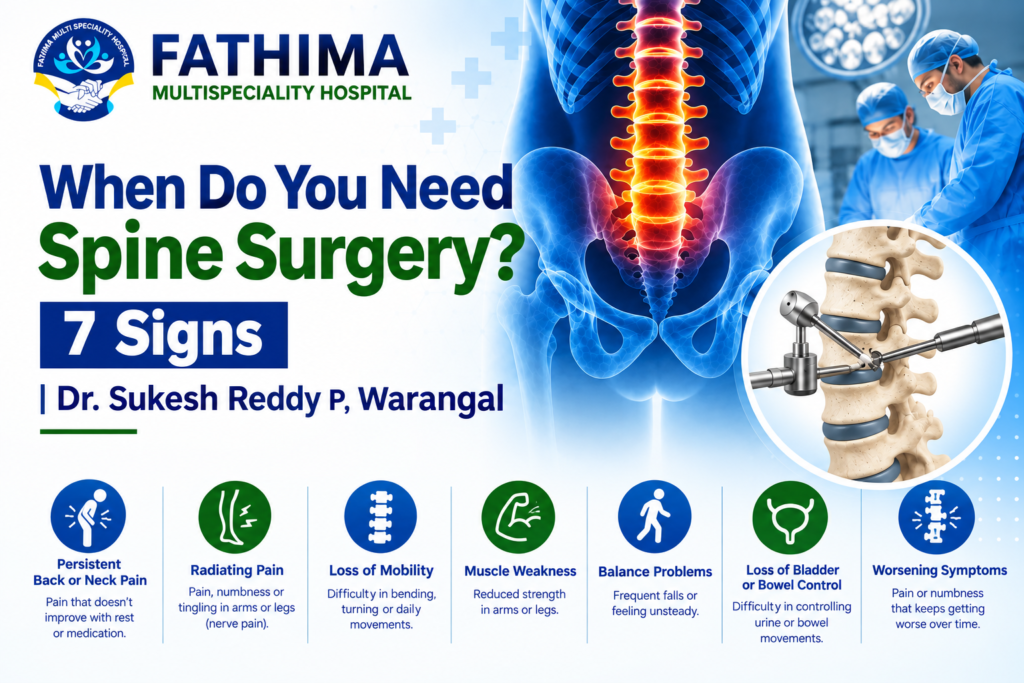
You may need to see a spine surgeon if back or neck pain lasts more than a few weeks, spreads into an arm or leg, comes with numbness or weakness, keeps getting worse, or has not improved with proper non-surgical treatment. Seeing a surgeon does not mean you will have an operation. Most spine problems improve without surgery, and a specialist’s job is to tell you which category you fall into. In Warangal, you can be assessed by Dr. Sukesh Reddy P at Fathima Multispeciality Hospital, Hanamkonda.
No. This is the most important thing to know. Many people with disc bulges, arthritis, or nerve irritation recover with medication, physiotherapy, posture correction, and time. Surgery is usually a later step, kept for specific situations:
So the real question is not “Do I need an operation?” but “Do I need an expert opinion?” These seven signs help you answer that.
Ordinary muscle strain usually settles within days to a couple of weeks. Pain that lingers for six weeks or more, or keeps returning, deserves proper evaluation. Common causes include a herniated disc, spinal stenosis, or joint degeneration.
Pain that shoots down the leg (often called sciatica) or into the arm usually means a nerve is irritated or compressed. The location of the pain helps a doctor identify which level of the spine is involved.
These are nerve symptoms, not just pain. Signs include a weaker grip, dropping objects, a foot that drags or feels heavy, or pins and needles that keep coming back. Do not dismiss them as tiredness or a bad sleeping position, especially if they persist.
If you have followed a sensible plan of medication, physiotherapy, exercise, and activity changes for several weeks with little improvement, it is time to reassess. The answer may be a different non-surgical approach, such as targeted injections or a modified rehab program, rather than surgery.
Notice how much space the pain takes up. Can you sit through a meeting, drive for an hour, climb stairs, sleep through the night, or play with your children? When routine activities start shrinking, the problem has moved beyond a minor inconvenience.
Stable symptoms and worsening symptoms are very different. Increasing pain, spreading numbness, or growing weakness can mean pressure on the nerves is rising. Earlier assessment usually gives you more treatment options.
An MRI can look alarming without meaning surgery is necessary. Many people have disc bulges or degeneration on scans and no symptoms at all. What matters is whether the scan matches your symptoms and examination. Surgery becomes a consideration when imaging shows clear nerve or cord compression that fits what you are feeling.
Some symptoms should never wait for an appointment. Go to an emergency department if you have:
These can indicate serious spinal cord or nerve compression, infection, or fracture that needs urgent treatment.
Situation | Usual first step | Surgery considered? |
Recent back pain, no leg symptoms | Rest, medication, physiotherapy | Rarely |
Sciatica for a few weeks | Conservative treatment, review | Only if it persists |
Leg or arm weakness that is progressing | Prompt specialist review | Often, if compression is confirmed |
Bladder or bowel changes with back pain | Emergency evaluation | Frequently urgent |
Spinal instability or slipped vertebra | Specialist assessment | Depends on severity |
Significant MRI changes but mild symptoms | Observation, rehab | Usually not |
This table is a general guide. Only an examination and your scans can determine your own path.
A thorough visit typically includes:
Dr. Sukesh Reddy P is an orthopedic surgeon at Fathima Multispeciality Hospital, Hanamkonda, with more than 13 years of experience. He holds an MBBS and MS (Orthopaedics) with a fellowship in joint replacement. His practice covers spine care, trauma, arthroscopic (keyhole) surgery, and joint replacement.
Patients see him for back pain, slipped discs, sciatica, and other spinal conditions. His approach is to explain the problem in plain language and recommend the least invasive option that will safely work, whether that is rehabilitation, minimally invasive surgery, or open surgery.
There is no single price, because the cost depends on:
Ask the hospital for a written, itemised estimate that states what is included. A lower price is not automatically better, so weigh it alongside the surgeon’s experience and the hospital’s support facilities.
📍 Fathima Multispeciality Hospital, Hanamkonda, Warangal
📞 +9194947 32200
🌐 fathimahospitals.in
Frequently Asked Questions (FAQ’s)
1Q: Can back pain go away without surgery?
Ans: Yes. Most back and neck problems improve with medication, physiotherapy, exercise, and activity changes. Surgery is reserved for specific conditions.
2Q: When should I see a spine surgeon for back pain?
Ans: See one if pain lasts more than a few weeks, spreads down a limb, comes with numbness or weakness, disturbs daily life, or keeps worsening. Seek emergency care for bladder or bowel changes or sudden leg weakness.