

Ortho Hospital in Hanamkonda | Fathima Multispeciality Hospital
A patient-friendly, step-by-step breakdown of robotic knee replacement — from 3D imaging to recovery — by Dr. Sukesh Reddy P at Fathima Multispeciality Hospital, Warangal
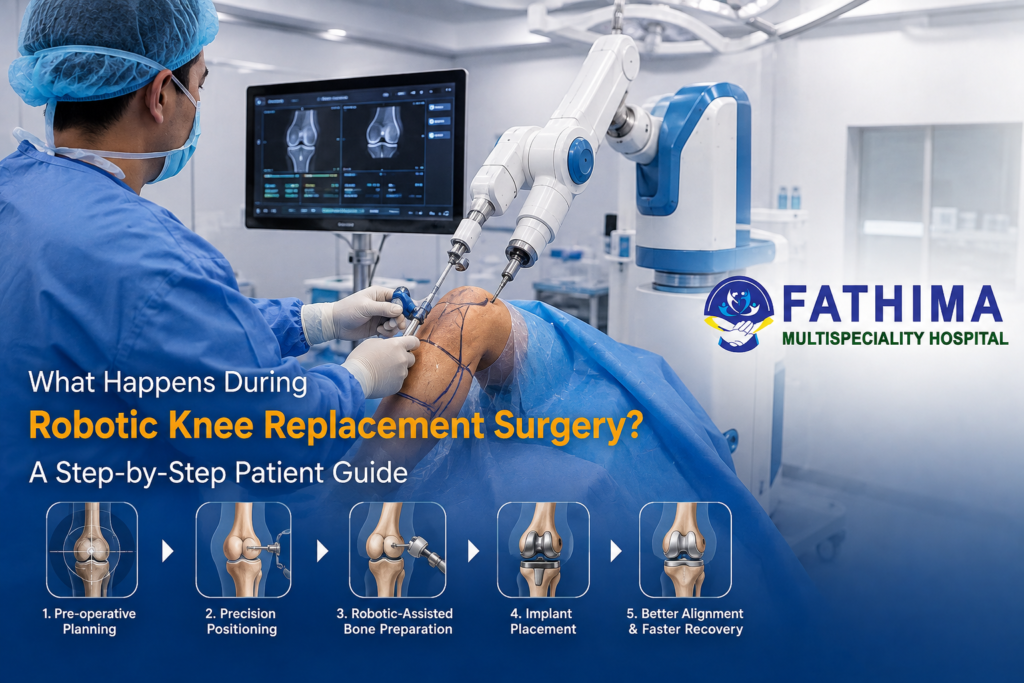
Robotic knee replacement uses a robotic arm and 3D CT-based mapping to help the surgeon plan bone cuts and implant placement with sub-millimeter accuracy, while the surgeon performs and controls every step of the operation. The process moves through pre-surgical imaging, blood work and anaesthesia clearance, robotic mapping in the operating room, precise bone preparation, implant fitting, and closure — followed by early mobilization and physiotherapy. In Warangal, Dr. Sukesh Reddy P at Fathima Multispeciality Hospital is the region’s first and only robotic knee replacement surgeon, meaning patients no longer need to travel to Hyderabad for this level of surgical precision.
Robotic knee replacement surgery is performed by an orthopedic surgeon using a robotic-arm system for guidance — the robot does not operate independently. Before surgery, a CT scan builds a 3D model of the patient’s knee so the surgeon can plan the exact size, position, and angle of the implant in advance. In the operating room, the robotic arm helps the surgeon execute that plan with real-time feedback, correcting for even small deviations in bone alignment. Damaged cartilage and bone are removed with high precision, the implant is seated and tested for movement and stability, and the incision is closed. Most patients stand and begin walking with support within a day of surgery.
In conventional knee replacement, the surgeon relies on manual instruments and visual judgment to size and align the implant. Robotic-assisted surgery adds a layer of computer-guided precision on top of the surgeon’s skill: the system continuously maps the joint during the procedure and keeps bone cuts within fractions of a millimeter of the surgical plan. This tends to translate into better implant alignment, less disturbance to the tissue around the joint, and — for many patients — a smoother, faster recovery.
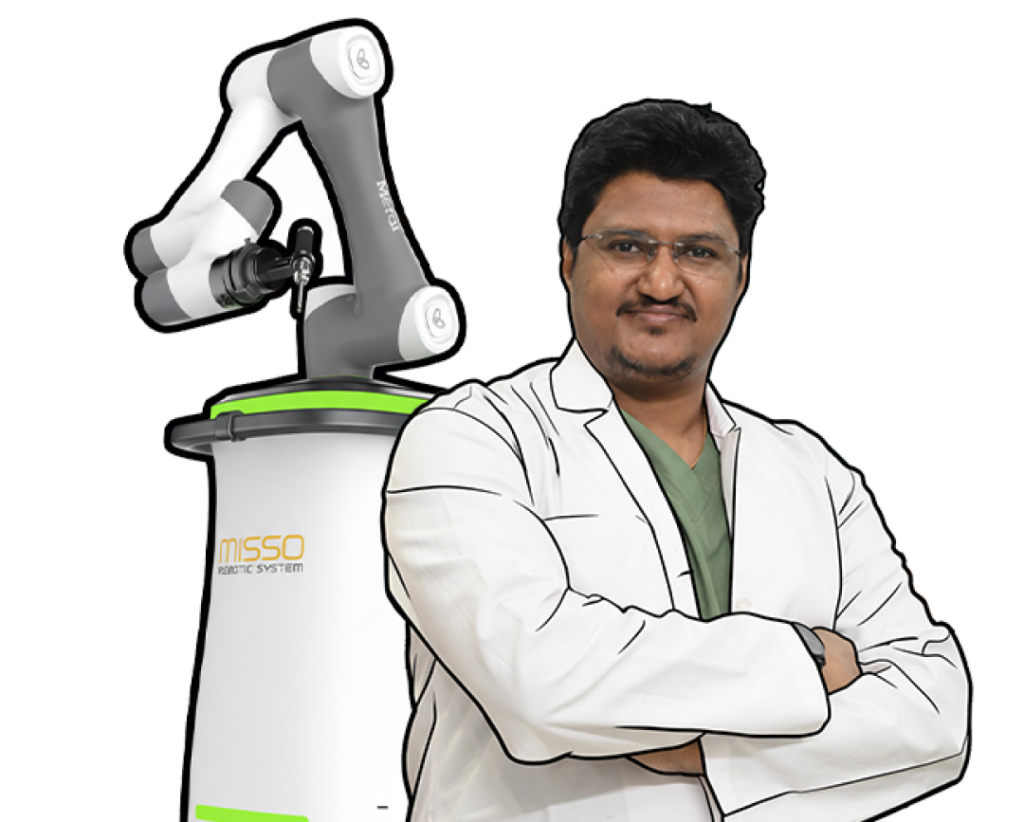
It’s worth being clear on one point patients often ask about: the robot does not perform the surgery. The surgeon makes every clinical decision and can adjust the plan mid-procedure if the patient’s anatomy calls for it. The robotic arm is a precision tool in the surgeon’s hands, similar to how GPS assists a driver without taking over the wheel.
Step i: Clinical Assessment and 3D Imaging
The process starts with a physical examination and a detailed history of your symptoms. A CT scan of the knee is then taken and converted into a 3D digital model, giving the surgeon a precise map of your unique bone structure ahead of the operation. This step is what allows the surgical plan — implant size, position, and cutting angles — to be finalized before you ever enter the operating room.
Step ii: Pre-Operative Workup
You’ll go through routine blood tests to rule out infection or inflammation, a medication review (certain drugs like blood thinners are usually paused beforehand), and fasting instructions ahead of anaesthesia. This stage exists to make sure your body is ready for surgery and anaesthesia safely.
Step iii: Anaesthesia and Positioning
On the day of surgery, spinal or general anaesthesia is administered. Your leg is then positioned to give the surgical team full access to the joint while keeping you stable and comfortable throughout the procedure.
Step iv: Robotic Mapping in the Operating Room
Once you’re under anaesthesia, the robotic system re-confirms the joint’s anatomy in real time, cross-checking it against the pre-surgical 3D plan. This live mapping step is what allows the surgeon to fine-tune cutting depth and implant placement to your actual knee on the table — not just the scan taken days earlier.
Step v: Bone Preparation and Implant Placement
Damaged cartilage and bone are removed with guided precision, disturbing as little of the surrounding soft tissue as possible. This is one of the biggest advantages of the robotic approach — sparing healthy tissue generally means less bleeding, less post-op swelling, and less pain. The implant is then placed and its fit, alignment, and range of motion are tested before closure.
Step vi: Closure and Immediate Recovery
The incision is closed, and you’re moved to a recovery room for monitoring. Physiotherapy typically starts within a day, focusing on gentle movement, muscle activation, and safe standing.
Recovery Stage | What Typically Happens |
Day 0–1 | Standing and walking with support (walker/frame) begins under supervision |
Day 3–5 | Most patients are walking with assistance; pain and swelling gradually reduce |
Week 2–3 | Transition from walker to cane; physiotherapy intensifies |
Week 6–8 | Return to most daily activities; independent walking for many patients |
Month 3+ | Continued strength and flexibility gains; long-term joint function stabilizes |
Individual recovery varies based on age, overall health, and adherence to physiotherapy.
Factor | Robotic Knee Replacement | |
Surgical planning | 3D CT-based, patient-specific plan | Based on X-rays and manual measurement |
Precision | Real-time robotic guidance, sub-millimeter accuracy | Dependent on surgeon’s manual technique |
Tissue handling | Minimally disruptive to surrounding tissue | More manual tissue handling |
Typical recovery | Often faster mobilization | Standard recovery timeline |
Who performs it | Surgeon, robot-assisted | Surgeon, manual instruments only |
For patients across Warangal, Hanamkonda, Karimnagar, and Khammam, robotic knee replacement was previously only available by traveling to Hyderabad or Bangalore. Fathima Multispeciality Hospital has changed that by bringing this technology directly to the region.
If chronic knee pain is limiting your daily life — walking, climbing stairs, or sleeping through the night — a consultation with Dr. Sukesh Reddy P at Fathima Multispeciality Hospital is a practical starting point close to home.
Robotic knee replacement combines a surgeon’s clinical judgment with computer-guided precision to improve implant accuracy and support faster, more comfortable recovery. For patients in and around Warangal, that level of care is now available locally through Dr. Sukesh Reddy P at Fathima Multispeciality Hospital — eliminating the need to travel to a metro city for advanced orthopedic surgery.
To book a consultation or learn if robotic knee replacement is right for you, contact Fathima Multispeciality Hospital, Hanamkonda, Warangal.
1Q: What happens during robotic knee replacement surgery?
Ans: It begins with pre-operative CT imaging and 3D surgical planning. During the procedure, the surgeon uses the robotic system to guide bone preparation and implant positioning based on the patient’s specific knee anatomy. Damaged joint surfaces are removed, the implant is placed, and knee alignment and stability are tested before the incision is closed.
2Q: Does a robot perform the knee replacement surgery?
Ans: No. The orthopedic surgeon performs and controls the entire procedure. The robotic system provides real-time guidance so bone cuts and implant placement follow the surgical plan precisely, but the surgeon makes every clinical decision and can adjust the approach as needed.
H No 1-1-1106, Beside Over Bridge Sidharthnagar, Street No 7, Hanamkonda, Telangana - 506004