
Robotic knee replacement surgery often delivers better results than traditional knee replacement for many patients. Surgeons achieve higher precision, personalize implant alignment, and create more predictable outcomes. These advantages can support faster recovery and improved long-term knee function.
However, the ideal surgical approach depends on the patient’s knee condition, overall health, and the surgeon’s expertise.
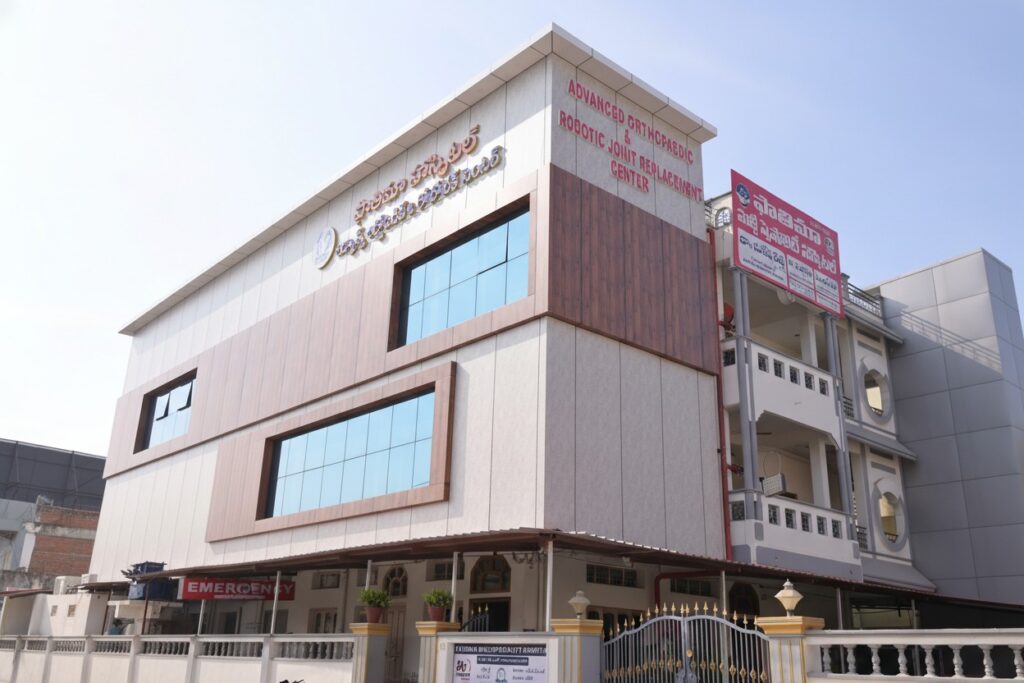
At Fathima Multispeciality Hospital, orthopedic specialists use advanced robotic technology to perform precise, patient-specific knee replacement procedures.
1. Why Knee Replacement Surgery Is Needed
Knee pain caused by osteoarthritis, cartilage damage, or age-related joint degeneration often interferes with daily life. Patients struggle with simple activities such as walking, climbing stairs, or standing for long periods.
When non-surgical treatments such as:
- medications
- injections
- physiotherapy
- lifestyle changes
fail to provide lasting relief, knee replacement surgery helps restore mobility and significantly reduce pain.
2. What Is Traditional Knee Replacement Surgery?
In traditional knee replacement surgery, surgeons remove damaged portions of the knee joint and replace them with an artificial implant. They use manual instruments and alignment guides and rely on experience and visual judgment to position the implant.
Orthopedic surgeons have successfully performed this technique for decades, and it continues to produce good outcomes, especially in experienced hands.
i. Limitations of Traditional Knee Replacement
- Implant alignment may vary slightly
- Surgeons follow a standardized approach
- Results depend heavily on individual anatomy and surgical technique
3.What Is Robotic-Assisted Knee Replacement Surgery?
Robotic-assisted knee replacement uses computer-guided technology to support the surgeon during surgery. Before the procedure, specialists create a detailed 3D model of the patient’s knee to plan the operation accurately.
The surgery is not carried out autonomously by the robotic device. Instead, it provides real-time feedback and controlled guidance. This support allows the surgeon to place the implant with exceptional accuracy and achieve optimal joint balance.
4. Advanced Robotic Knee Surgery in Warangal
Fathima Multispeciality Hospital is the only hospital in Warangal equipped with an advanced robotic knee replacement system. This technology enables the orthopedic team to deliver highly precise and personalized knee replacement surgeries for patients across the region.
5. Robotic Knee Replacement vs Traditional Surgery
| Feature | Traditional Surgery | Robotic-Assisted Surgery |
| Implant alignment | Manual estimation | Computer-guided precision |
| Surgical planning | Standard approach | Personalized to knee anatomy |
| Accuracy | Surgeon-dependent | Highly consistent |
| Soft tissue protection | Moderate | Improved control |
| Recovery | Variable | Often faster |
| Long-term outcomes | Generally good | More predictable |
5. Benefits of Robotic Knee Replacement
i. Higher Precision and Accuracy
Robotic guidance allows surgeons to prepare bone surfaces precisely and position implants accurately, improving joint alignment and stability.
ii. Personalized Surgical Planning
Every knee differs in shape and movement. Robotic technology enables surgeons to customize the procedure instead of using a one-size-fits-all method.
iii. Faster Recovery and Reduced Pain
By protecting surrounding tissues, robotic surgery often results in:
- less post-operative pain
- reduced blood loss
- earlier walking and rehabilitation
iv. Improved Long-Term Knee Function
Accurate implant alignment improves knee movement and may increase implant longevity over time.
6. Is Robotic Knee Replacement Safer?
Clinical experience shows that robotic-assisted knee replacement improves surgical control and reduces alignment-related errors. Real-time feedback allows surgeons to make precise adjustments during surgery.
Overall safety depends on:
- surgeon expertise
- proper patient selection
- structured post-operative care and physiotherapy
7. Who Benefits Most From Robotic Knee Replacement?
Robotic knee replacement may suit patients who:
- have advanced knee arthritis
- experience long-term knee pain
- seek predictable surgical outcomes
- are medically fit for surgery
Orthopedic specialists must perform a detailed evaluation to confirm eligibility.
8.When Do Surgeons Recommend Traditional Knee Replacement?
Traditional knee replacement remains a good option when:
- knee deformity is mild
- robotic assistance is not necessary
- an experienced orthopedic surgeon performs the procedure
Both techniques can produce excellent outcomes when surgeons select the right approach for each patient.
9. Conclusion: Which Knee Replacement Is Better?
For many patients, robotic-assisted knee replacement offers clear advantages, including superior precision, personalized alignment, and potentially faster recovery.
With advanced robotic systems and experienced orthopedic specialists, Fathima Multispeciality Hospital delivers world-class robotic knee replacement surgery in Warangal. Patients should always make the final treatment decision after consulting a qualified orthopedic surgeon
FAQ’s
Most patients report less post-operative pain due to precise bone cuts and minimal soft tissue damage.
Most patients begin walking within 2–3 days under guided physiotherapy.
Accurate implant alignment may improve implant longevity and long-term knee performance, although results vary by patient.