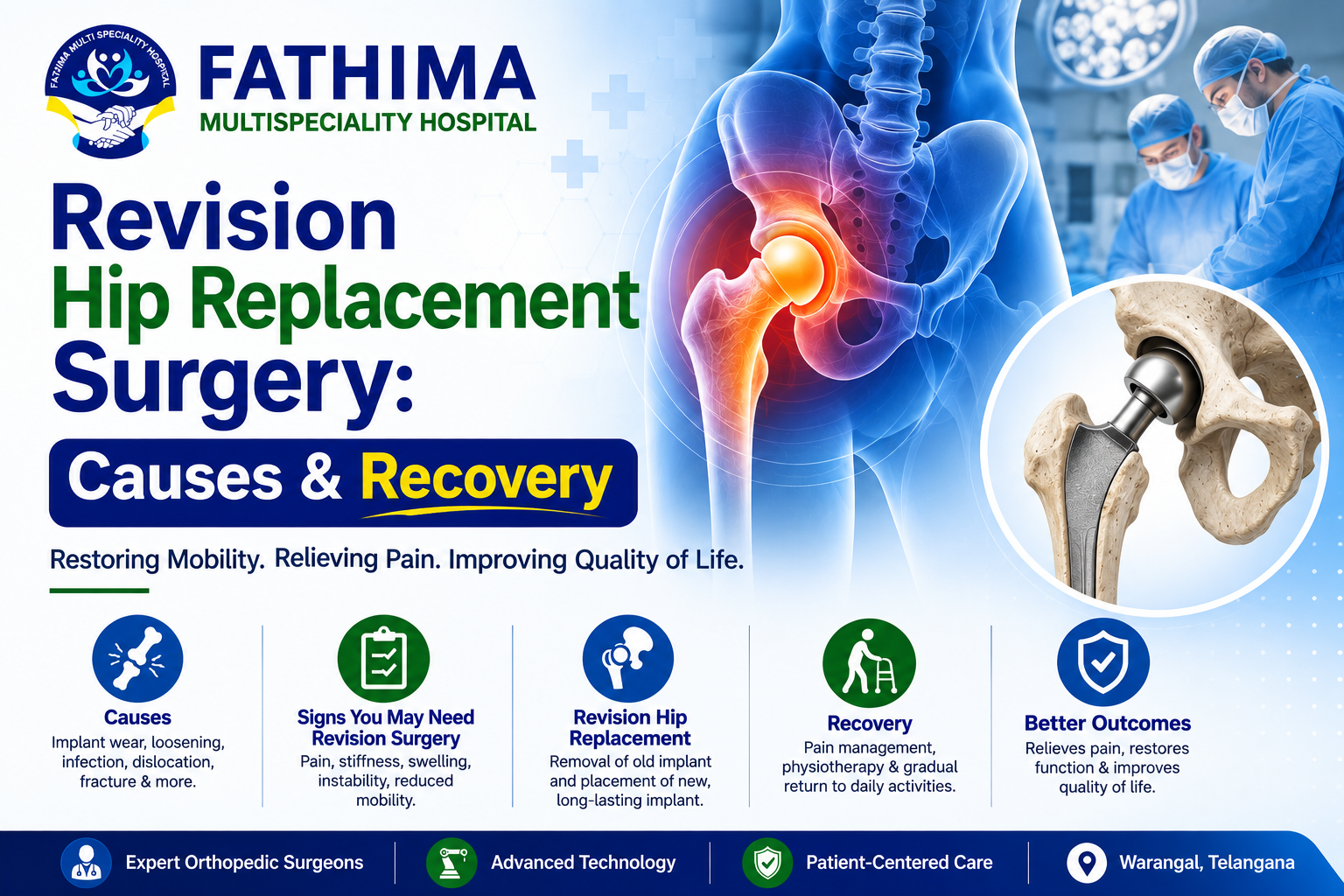
Revision Hip Replacement Surgery: Causes & Recovery
Why do hip replacements fail and need a second surgery? Causes, warning signs, and recovery guide by Dr. Sukesh Reddy P, Fathima Hospitals, Warangal
Revision hip replacement is a second surgery performed when a previous hip implant fails — due to loosening, infection, dislocation, wear, or fracture around the implant. It’s technically more demanding than a first-time hip replacement because the surgeon must remove the existing implant, address any bone loss, and rebuild a stable joint, often in patients who are older or have weaker bone. In Warangal, Dr. Sukesh Reddy P at Fathima Multispeciality Hospital brings advanced, precision-guided orthopedic techniques to both first-time and revision joint replacement, so patients don’t need to travel to Hyderabad for this level of complex surgical care.
Revision hip replacement becomes necessary when a previously implanted hip prosthesis stops functioning properly. The most common reason is aseptic loosening, where the implant gradually separates from the surrounding bone without infection being involved. Other causes include infection around the implant, recurrent dislocation, fracture of the bone or the implant itself following a fall or injury, long-term wear of implant components, and — occasionally — an allergic reaction to the metal used. When any of these occur, the surgeon removes some or all of the original implant and replaces it with new components, aiming to restore stability, reduce pain, and rebuild hip function.
Watch for these symptoms if you have an existing hip implant:
If you notice any of these signs, don’t wait — early evaluation can prevent further joint or bone damage.
Factor | Primary Hip Replacement | Revision Hip Replacement |
Implant handling | New implant placed into healthy bone | Old implant must first be removed, often firmly fixed |
Bone quality | Generally strong, undamaged bone | May be weakened by wear, loosening, or infection |
Surgical time | Comparatively shorter | Longer, more technically demanding |
Blood loss | Lower | Typically higher |
Patient profile | Often first presentation, varied age | Frequently older patients, more comorbidities |
Complication risk | Lower | Higher, requires more careful planning |
Recovery | Standard rehabilitation timeline | Often longer, depending on extent of reconstruction |
Removing a well-fixed implant without damaging surrounding bone is a delicate task, and if bone loss has occurred, the surgeon may need to use bone grafts or specialized implants to rebuild a stable foundation. This is why revision hip replacement is generally performed by surgeons experienced specifically in complex joint reconstruction.
Recovery timelines vary more in revision surgery than in primary hip replacement, largely because they depend on how much bone reconstruction was needed.
Recovery Stage | What Typically Happens |
Day 0–2 | Early mobilization with assistance, where appropriate |
Week 1–2 | Physiotherapy begins, focused on safe weight-bearing and hip movement |
Week 3–6 | Gradual progression from walker to cane, depending on bone healing |
Month 2–3+ | Continued strength, balance, and mobility gains; weight-bearing restrictions lifted per surgeon guidance |
Patients who required significant bone reconstruction may have longer weight-bearing restrictions and a more gradual rehabilitation program than those undergoing a straightforward implant exchange.
Precision-guided and robotic-assisted techniques — already well established in primary joint replacement — are increasingly used in revision procedures too, helping surgeons plan implant removal and placement more accurately around compromised bone. This can support better implant alignment and fit even in the more challenging anatomy that revision cases often present.
Patients across Warangal, Hanamkonda, Karimnagar, and Khammam previously needed to travel to Hyderabad for advanced or revision joint replacement care. Fathima Multispeciality Hospital now offers this expertise locally.
If you’re experiencing new or worsening pain around a previous hip implant, don’t delay evaluation. A consultation with Dr. Sukesh Reddy P at Fathima Multispeciality Hospital is a practical first step toward diagnosis and treatment.
Conclusion
A failing hip implant doesn’t mean your options have run out — revision hip replacement can restore stability and reduce pain, even though the procedure is more complex than the original surgery. Early evaluation of new or worsening hip symptoms matters, and for patients in and around Warangal, that expertise is available locally through Dr. Sukesh Reddy P at Fathima Multispeciality Hospital.
If you’re experiencing symptoms of a failing hip implant, book a consultation with Fathima Multispeciality Hospital, Hanamkonda, Warangal, for evaluation and treatment options.
Frequently Asked Questions (FAQ’s)
1Q: Who performs revision hip replacement surgery in Warangal?
Ans: Dr. Sukesh Reddy P at Fathima Multispeciality Hospital, Hanamkonda, treats complex and revision joint replacement cases, bringing advanced orthopedic care to patients across the Warangal region.
2Q: Why do some patients need revision hip replacement surgery?
Ans: Revision surgery is performed when a previous hip replacement develops a significant problem — most commonly implant loosening, infection, instability, wear, or fracture. The surgeon removes some or all of the existing implant and replaces it to restore hip stability and function.