Ortho Hospital in Hanamkonda | Fathima Multispeciality Hospital
Minimally invasive spine surgery treats disc and spine issues via small incisions for faster recovery. Guide by Dr. Sukesh Reddy P, Fathima Hospitals, Warangal
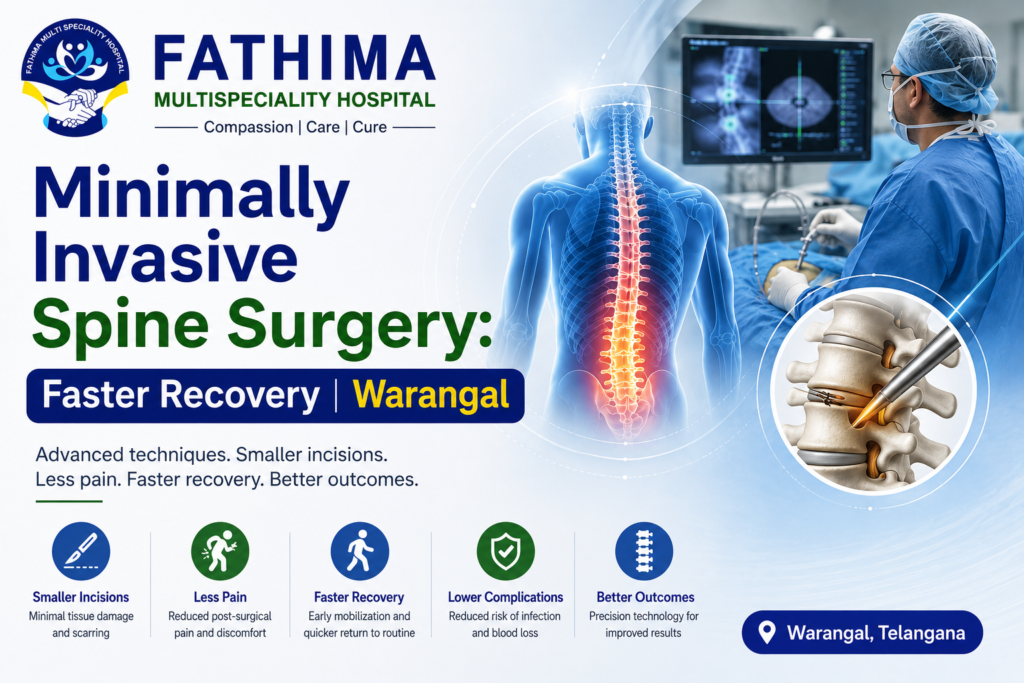
Minimally invasive spine surgery (MISS) treats conditions like herniated discs, spinal stenosis, and degenerative disc disease through small incisions and tube-based access, instead of the large, muscle-cutting incisions used in traditional open spine surgery. This means less blood loss, smaller scars, lower infection risk, and faster mobilization for suitable patients. In Warangal, Dr. Sukesh Reddy P at Fathima Multispeciality Hospital offers advanced, minimally invasive approaches to spine care — including robotic-assisted precision where appropriate — so patients no longer have to travel to Hyderabad for modern spine treatment.
Minimally invasive spine surgery is a technique where the surgeon reaches the spine through small incisions — often less than an inch — using a tube-based access system and, in many cases, an endoscope or microscope for visualization. Instead of cutting through large sections of back muscle to expose the spine, the surgeon works through this narrow channel with specialized instruments, treating the affected disc, nerve, or vertebra while leaving surrounding tissue largely undisturbed. This approach can be used for discectomy, spinal decompression, spinal fusion, and fixation procedures, and is generally associated with less post-operative pain and a quicker return to daily activity compared with open spine surgery.
Open spine surgery typically requires a longer incision and more extensive muscle retraction to give the surgeon a clear view of the spine — this can mean more blood loss, more post-operative pain, and a longer hospital stay. Minimally invasive techniques were developed specifically to reduce this “surgical footprint.” By working through a narrow tube rather than a wide-open incision, the surgeon limits disruption to healthy muscle and soft tissue around the spine, which is often the biggest factor separating a slow recovery from a fast one.
It’s important to note that MISS is not right for every spinal problem. Complex deformities, large tumors, or multi-level reconstructions may still require an open approach for adequate access. A qualified spine surgeon determines candidacy based on your imaging, symptoms, and overall spinal condition.
Step i: Diagnosis and Imaging
Your surgeon starts with a physical examination followed by imaging — CT, MRI, or X-rays — to pinpoint the exact location and extent of spinal damage. This determines whether your condition is localized enough for a minimally invasive approach.
Step ii: Pre-Surgical Preparation
You’ll be guided on stopping certain medications (like blood thinners) that can interfere with healing, quitting smoking if applicable, fasting instructions before anaesthesia, and arranging help at home for the first couple of weeks after discharge. Staying active with gentle stretching beforehand can also support a smoother recovery.
Step iii: Anaesthesia
On the day of surgery, local or general anaesthesia is administered depending on the procedure and your specific case.
Step iv: Accessing the Spine
A small incision is made in the back, chest, or abdomen — depending on where the problem is located — and a tube is guided in. An endoscope or camera-equipped instrument is then inserted through this tube so the surgeon can visualize the spine directly on a screen.
Step v: Treating the Affected Area
Specialized instruments are passed through the tube to remove damaged disc material, decompress a pinched nerve, or place fixation hardware, depending on the diagnosis. Retractors briefly hold tissue aside for visibility and are removed once the repair is complete, allowing surrounding muscle to return to its natural position.
Step vi: Closure and Recovery
The incision is closed and bandaged. Because so little tissue was disturbed, many patients are up and moving sooner than they would be after open spine surgery.
Just as robotic systems have transformed joint replacement, they’re increasingly used in spine surgery for precise screw placement and implant positioning during minimally invasive fusion procedures. Robotic and navigation-assisted techniques help the surgeon confirm exact anatomical landmarks in real time, which can translate into greater accuracy, less bleeding, smaller scars, and reduced inflammation from soft-tissue handling. Not every spine procedure requires robotic assistance — your surgeon will advise if it’s appropriate for your specific case.
Factor | Minimally Invasive Spine Surgery | Open Spine Surgery |
Incision size | Small (often under 1 inch) | Larger incision required |
Muscle/tissue disruption | Minimal — tube-based access | More extensive retraction |
Blood loss | Generally lower | Generally higher |
Hospital stay | Often shorter | Typically longer |
Recovery/mobilization | Faster for suitable patients | Slower, more gradual |
Best suited for | Localized, well-defined spinal issues | Complex deformities, large tumors, multi-level reconstruction |
Recovery Stage | What Typically Happens |
Day 0–2 | Early mobilization for many procedures; pain management prioritized |
Week 1–2 | Light activity resumes; incision care and initial follow-up |
Week 3–6 | Gradual return to routine daily activities |
Week 6+ | Strenuous activity, heavy lifting, and physically demanding work reintroduced only with surgeon clearance |
Recovery timelines vary significantly based on the specific procedure, condition treated, and individual health factors.
Patients across Warangal, Hanamkonda, Karimnagar, and Khammam previously had to travel to Hyderabad for advanced spine care. Fathima Multispeciality Hospital has brought this expertise closer to home.
If chronic back or neck pain, numbness, or nerve-related symptoms are affecting your daily life, a consultation with Dr. Sukesh Reddy P at Fathima Multispeciality Hospital is a practical first step.
Key Takeaway
Modern, minimally invasive spine surgery allows many patients to be treated with smaller incisions, less tissue damage, and a faster path back to daily life — without compromising surgical precision. For patients in and around Warangal, this level of care is available locally through Dr. Sukesh Reddy P at Fathima Multispeciality Hospital.
To find out if minimally invasive spine surgery is right for your condition, book a consultation with Fathima Multispeciality Hospital, Hanamkonda, Warangal.
Frequently Asked Questions (FAQ’s)
1Q: Who is the best spine surgeon in Warangal?
Ans: Dr. Sukesh Reddy P at Fathima Multispeciality Hospital, Hanamkonda, is a trusted choice for spine and orthopedic care in the Warangal region, offering minimally invasive and technology-assisted treatment options.
2Q: What technology is used in modern spine surgery?
Ans: Advanced imaging (CT/MRI), intraoperative navigation, endoscopic visualization, and — in select cases — robotic assistance for implant placement are used to improve surgical precision and outcomes.
H No 1-1-1106, Beside Over Bridge Sidharthnagar, Street No 7, Hanamkonda, Telangana - 506004