
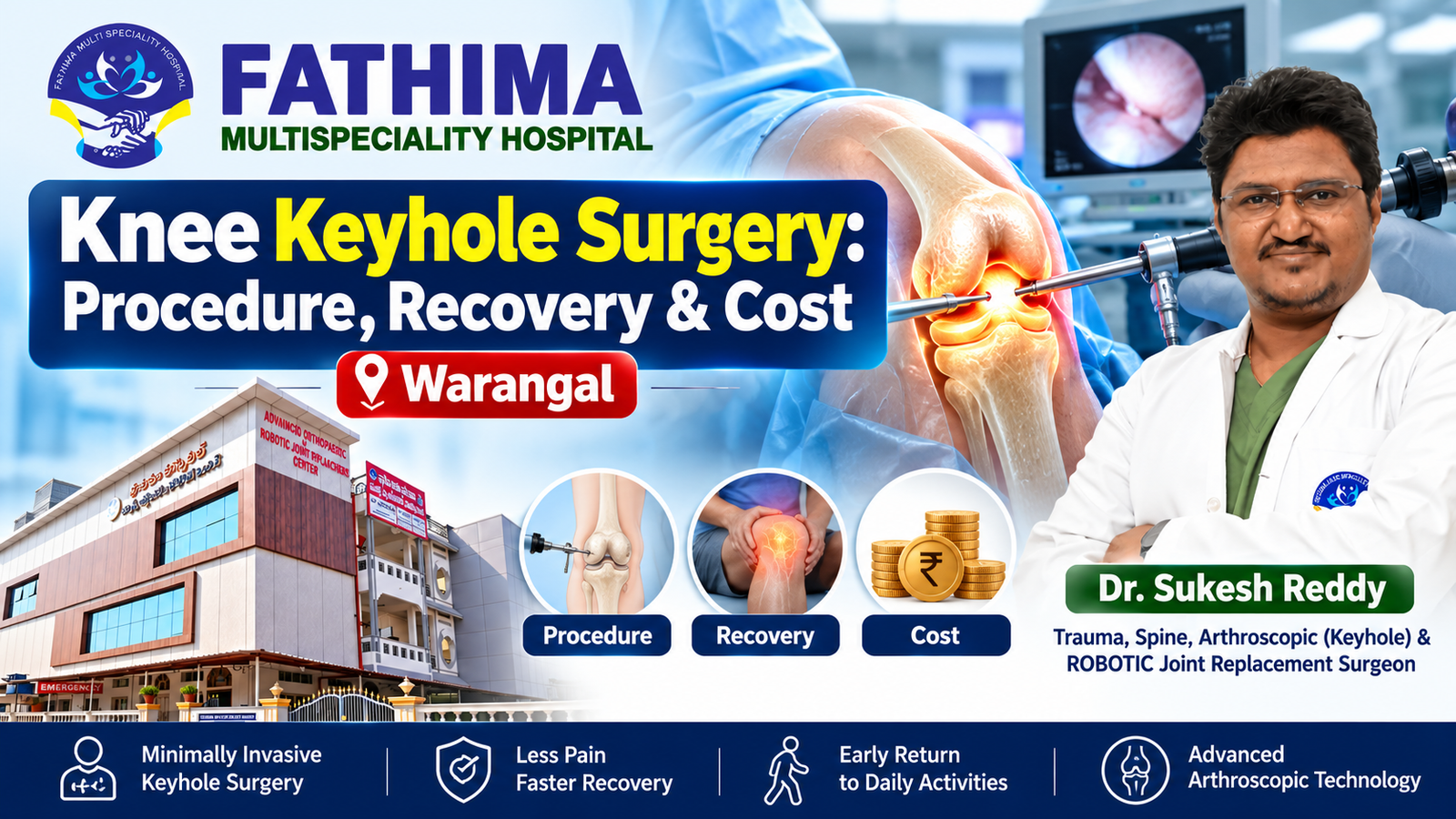
Knee Keyhole Surgery: Procedure, Recovery & Cost | Warangal
What is knee keyhole surgery? Learn which knee problems it treats, the step-by-step procedure, recovery timeline and risks. Book at Fathima Hospitals, Hanamkonda.
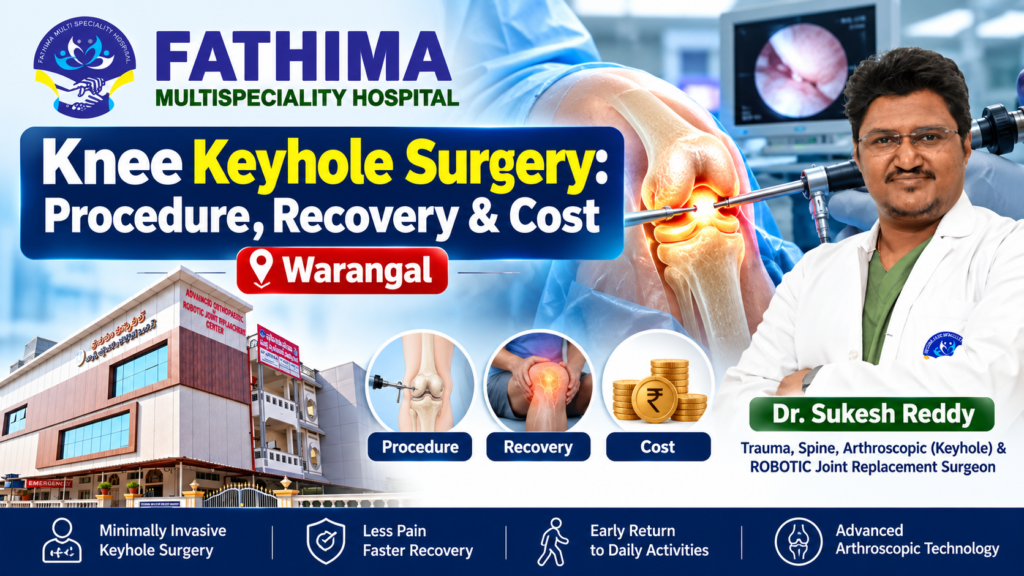
Knee keyhole surgery (knee arthroscopy) is a minimally invasive procedure in which an orthopaedic surgeon inserts a thin camera and small instruments through two or three small incisions, each well under 1 cm, to diagnose and repair problems inside the knee joint, such as meniscus tears and ligament injuries. Most patients go home the same day.
Knee keyhole surgery is the everyday name for knee arthroscopy. Instead of opening the joint with one large cut, the surgeon makes small “keyhole” incisions. Through one, a pencil-thin camera (the arthroscope) sends live images of the joint to a monitor. Through the others, fine instruments trim, repair or remove damaged tissue.
Because the surgeon sees inside the knee in high magnification, the same procedure is used for both diagnosis (finding the cause of pain that scans cannot fully explain) and treatment (fixing the problem in the same sitting).
Knee arthroscopy is most useful for mechanical problems inside the joint. Common reasons surgeons recommend it:
Keyhole surgery works best when a specific, repairable structure is causing symptoms such as locking, catching, giving way or a sudden twisting injury, especially in younger or active people.
It is often not the best first step for general wear-and-tear pain. Large randomised trials found that for degenerative meniscus tears linked to arthritis, arthroscopy often did no better than a structured exercise programme. Arthroscopy treats the tear, not the arthritic wear, so background aching may continue.
That is why a good surgeon will usually try physiotherapy, medication, weight management and injections first when there is no locking. If you have advanced arthritis, the better question may be whether joint preservation or replacement is appropriate. Only a clinical examination and X-ray or MRI can decide this for your knee.
Most procedures take 30 to 60 minutes, longer for complex repairs.
Recovery depends mostly on what was done inside the knee. A simple meniscus trim recovers in weeks; a repair or ligament reconstruction takes months.
Procedure | Walking without support | Desk work | Return to sport |
Meniscus trim (meniscectomy) | A few days to 2 weeks | About 1 week | 4–6 weeks (running); 6–8+ weeks (pivoting sports) |
Meniscus repair | 6–8 weeks (crutches and brace for 4–6 weeks) | 1–2 weeks | 3–6 months |
ACL reconstruction | Several weeks, with structured physiotherapy | Varies with the job | Typically around 6–9 months (approximate; surgeon-specific) |
Typical pattern after a simple procedure:
Full recovery is usually six weeks to three months for simple procedures. Physiotherapy is as important as the surgery itself.
Knee arthroscopy is considered very safe, but no surgery is risk-free. Possible complications are:
Call your surgeon the same day if you have: calf pain, swelling or warmth; fever above 38.3°C (101°F); spreading redness or cloudy drainage from a wound; pain that worsens after day three; or a sudden inability to bear weight.
Go to an emergency department immediately for chest pain, sudden breathlessness or coughing up blood, as these can signal a clot in the lung.
Patients in Warangal and the surrounding region can consult Dr. Sukesh Reddy P at Fathima Multispeciality Hospital, Hanamkonda. According to the hospital, the orthopaedic team is led by Dr. Sukesh Reddy (MS Ortho). His website describes him as an orthopaedic surgeon specialising in adult reconstruction and robotic joint replacement.
Orthopaedic services listed on the two websites include:
The hospital lists a robotic operation theatre, advanced diagnostics and imaging, ICU and critical care, physiotherapy and 24/7 service, which matters because safe knee surgery depends on good imaging beforehand and good rehabilitation afterwards.
Hospital: Fathima Multispeciality Hospital, H No 1-1-1106, beside Over Bridge, Sidharthnagar, Street No 7, Hanamkonda, Telangana 506004
Phone / appointments: +91 94947 32200
Bring any previous X-rays, MRI reports and a list of current medicines to your first visit, so the surgeon can tell you whether keyhole surgery, physiotherapy or another treatment is right for your knee.
Frequently Asked Questions (FAQ’s)
1Q: Is knee keyhole surgery a major surgery?
Ans: It is considered minor to moderate. The incisions are small and most patients go home the same day, but it is still surgery done under anaesthesia.
2Q: How long does knee keyhole surgery take?
Ans: Usually 30 to 60 minutes, depending on what needs to be repaired.
H No 1-1-1106, Beside Over Bridge Sidharthnagar, Street No 7, Hanamkonda, Telangana - 506004