
What Is the Biggest Complaint After Knee Replacement? | Dr. Sukesh Reddy P, Warangal
Compare robotic vs conventional hip & knee replacement — precision, recovery, cost & risks. Expert orthopedic care at Fathima Hospitals, Warangal
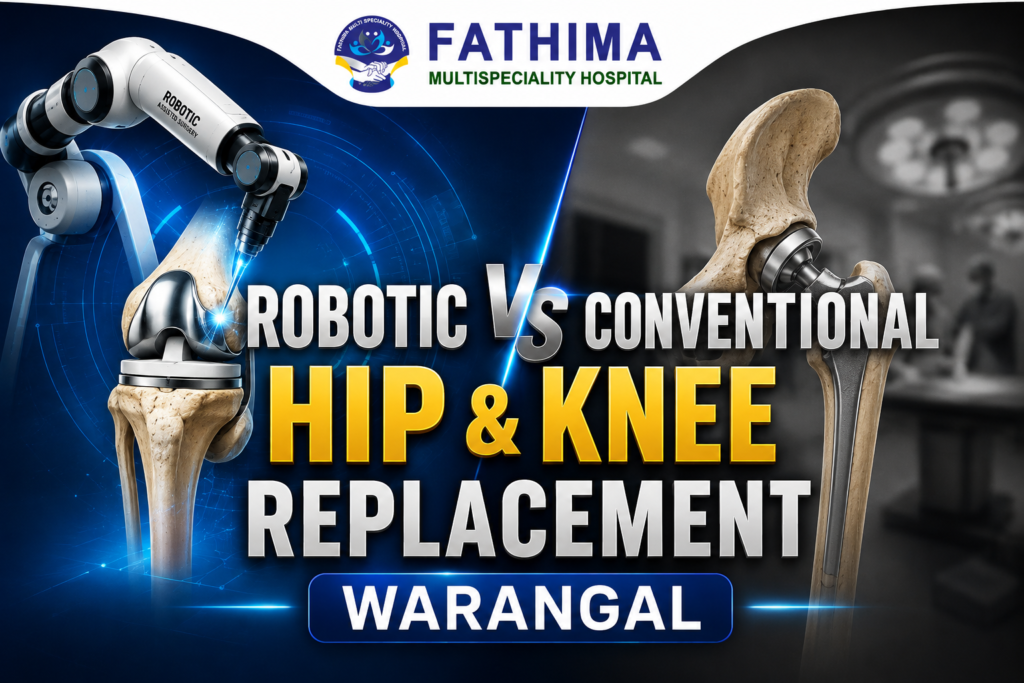
If knee or hip pain has started controlling your daily life — climbing stairs, sitting cross-legged, or even walking to the market feels harder than it used to — you may have already been told that joint replacement is the next step. And once that conversation starts, one question almost always follows: should you go for robotic joint replacement or conventional joint replacement?
At Fathima Hospitals, Warangal, our orthopedic team gets asked this every week. This guide breaks down both options in plain language — how each works, how they differ, and how to decide which is right for you.
Robotic-assisted hip and knee replacement uses computer-guided precision to plan and execute the surgery based on your unique anatomy, while conventional joint replacement relies on the surgeon’s manual skill, experience, and standard instruments. Both are safe, effective, and widely practiced. Robotic surgery generally offers greater implant accuracy and less soft-tissue disturbance, while conventional surgery remains a proven, accessible, and cost-effective option performed successfully for decades. The right choice depends on your joint condition, age, activity level, and budget — best decided with an experienced orthopedic surgeon.
Conventional hip or knee replacement is the traditional, time-tested surgical approach. The surgeon plans the procedure using X-rays, makes the incision, prepares the bone, and positions the implant entirely by hand — guided by years of training and clinical judgment.
This method has been refined over decades and continues to deliver excellent, reliable outcomes for the vast majority of patients, especially in straightforward cases handled by an experienced surgical team.
Key characteristics of conventional replacement:
Robotic-assisted joint replacement adds a layer of digital precision to the surgeon’s expertise. Before the operation, imaging (usually a CT scan) is used to build a detailed 3D model of your specific hip or knee. This model becomes a personalized surgical roadmap — showing exactly how much bone to remove, at what angle, and where the implant should sit for optimal alignment and joint mechanics.
During surgery, the robotic arm works within the boundaries mapped out for your anatomy, helping the surgeon stay precise and avoid unnecessary disturbance to healthy surrounding tissue.
Key characteristics of robotic replacement:
Factor | Robotic-Assisted | Conventional |
Surgical planning | 3D CT-based, patient-specific | Primarily 2D X-ray based |
Precision | High, guided by robotic arm within preset limits | Depends on surgeon’s manual skill |
Incision & tissue impact | Usually smaller, less soft-tissue disturbance | Slightly larger; more tissue handling |
Surgery duration | Slightly longer (extra planning/setup) | Usually quicker |
Typical hospital stay | Often shorter | Can be longer, especially in complex cases |
Cost | Higher | More affordable |
Availability | Only at hospitals with robotic systems | Widely available |
Track record | Growing, strong short-to-mid-term data | Decades of long-term outcome data |
Best suited for | Complex anatomy, revision cases, patients wanting maximum precision | Straightforward cases, patients prioritizing cost and accessibility |
Many patients do report a smoother early recovery after robotic surgery — likely linked to reduced tissue disruption and more precise implant alignment. However, overall recovery timelines can still vary widely from person to person, since healing also depends on age, pre-existing health conditions, weight, and how consistently you follow your physiotherapy plan. Robotic surgery isn’t a shortcut around rehabilitation — it simply gives your new joint a more accurate starting point.
Which One Should You Choose?
There’s no universal “better” option — only what’s better for you. Here’s what typically factors into the decision:
Both approaches — when performed by a skilled, experienced surgical team — lead to excellent long-term outcomes for the large majority of patients. Neither is automatically “inferior”; they’re simply different tools suited to different situations.
If joint pain is limiting your everyday life, you don’t have to travel far from Warangal for advanced orthopedic care. At Fathima Hospitals, our joint replacement team offers both robotic-assisted and conventional hip and knee replacement, with a treatment plan built around your specific condition — not a one-size-fits-all approach.
Our orthopedic specialists take time to walk you through your imaging, explain your options honestly, and help you weigh precision, recovery expectations, and cost so you can make a confident, informed decision.
📍 Fathima Hospitals, Warangal — trusted orthopedic and joint replacement care for patients across Telangana.
🌐 Learn more or book a consultation: fathimahospitals.in
Frequently Asked Questions (FAQ’s)
1Q: What is the difference between robotic and conventional hip & knee replacement?
Ans: Robotic joint replacement uses computer-guided, patient-specific 3D planning to help the surgeon achieve highly accurate implant placement, while conventional replacement relies on the surgeon’s manual skill and experience using standard imaging and instruments.
2Q: Is robotic hip or knee replacement more accurate than conventional surgery?
Ans: Yes, generally. Robotic-assisted surgery tends to offer greater accuracy in implant alignment and positioning, which can support better joint function and implant longevity, though outcomes still depend heavily on surgeon expertise in both approaches.