
What Is the Biggest Complaint After Knee Replacement? | Dr. Sukesh Reddy P, Warangal
Partial or total knee replacement — which is right for you? Compare recovery, ideal candidates & robotic options with Fathima Hospital, Warangal.
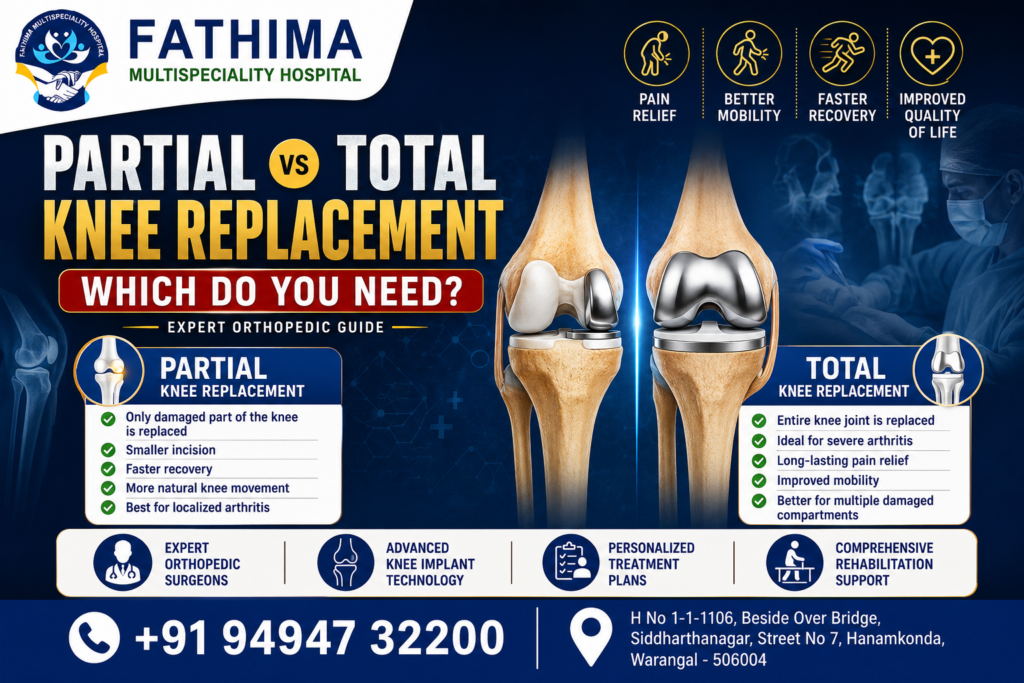
If your knee pain has reached the point where walking, climbing stairs, or even sitting cross-legged feels difficult, your doctor may have already mentioned knee replacement surgery. But there are two very different versions of this procedure — partial knee replacement and total knee replacement — and choosing the right one makes a real difference to your recovery time, function, and long-term results.
Partial knee replacement is suitable when arthritis or damage is limited to just one compartment of the knee, while total knee replacement is needed when two or more compartments are affected, or when the damage is widespread. Partial replacement usually means a smaller incision, faster recovery, and a more natural-feeling knee — but it’s not right for everyone. The only way to know which one you need is a proper clinical and imaging assessment by an orthopaedic surgeon.
Below, we break down the differences so you can have an informed conversation with your doctor.
Your knee joint is divided into three compartments:
Knee replacement surgery works by resurfacing damaged cartilage and bone in these compartments with metal and plastic implants. Whether you need one compartment replaced or all three determines which surgery is right for you.
Partial knee replacement (also called unicompartmental knee replacement) resurfaces only the damaged compartment, leaving the healthy bone, cartilage, and ligaments — including your natural ACL and PCL — untouched.
Best suited for patients who have:
Advantages:
Limitations:
Total knee replacement resurfaces all three compartments of the knee joint. It’s the more commonly performed procedure and is considered the gold standard for advanced, widespread knee arthritis.
Best suited for patients who have:
Advantages:
Considerations:
Factor | Partial Knee Replacement | Total Knee Replacement |
Compartments treated | One | All three |
Incision size | Smaller | Larger (minimally invasive options available) |
Hospital stay | Typically shorter | 1–3 days with robotic assistance |
Recovery time | Faster, often 2–4 weeks to normal activity | 4–8 weeks for full recovery |
Knee “feel” | More natural, preserves own ligaments | Excellent function, artificial joint |
Ideal candidate | Localized arthritis, active lifestyle | Widespread arthritis, deformity |
Long-term durability | Very good; may need revision later | Excellent, long-lasting |
One of the biggest advances in knee replacement — both partial and total — is robotic-assisted surgery. Robotic systems allow the surgeon to map your unique knee anatomy before the first incision is made, plan implant positioning with sub-millimetre accuracy, and execute the surgery with far greater precision than manual instrumentation alone.
This matters especially for partial knee replacement, where precise alignment is critical to protecting the healthy compartments that are left untouched. Poor alignment in a partial replacement can accelerate wear in the rest of the joint — robotic assistance significantly reduces this risk.
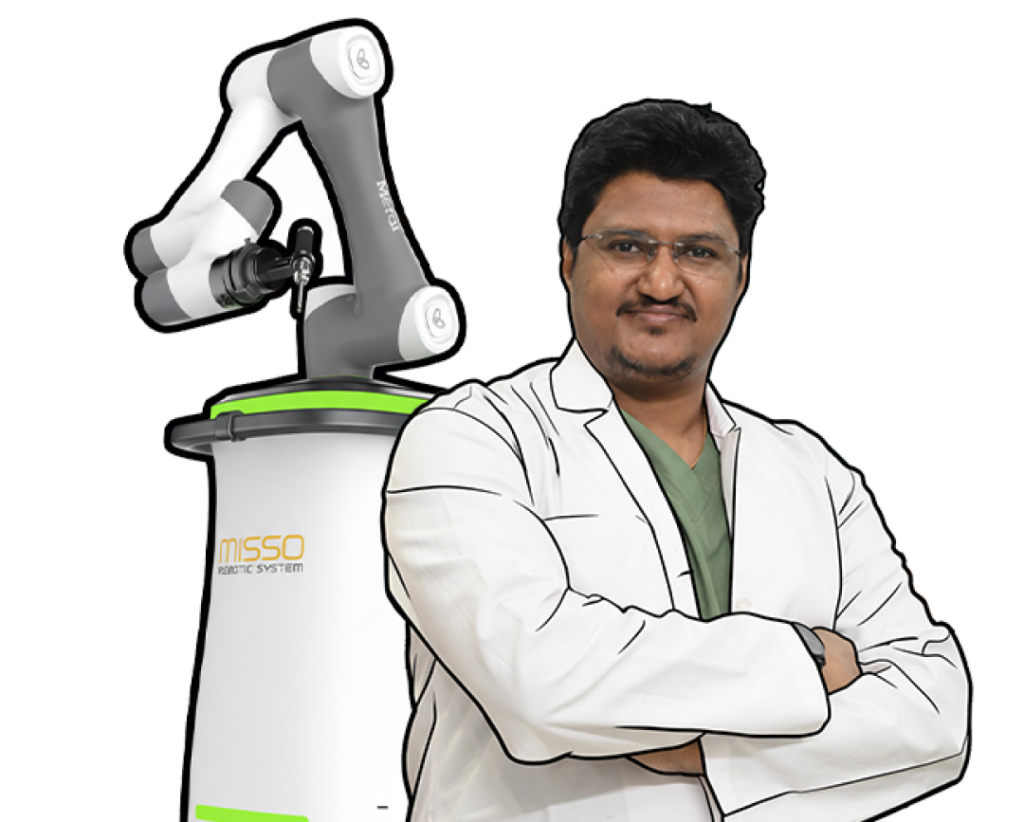
At Fathima Multispeciality Hospital in Warangal, we were the first hospital in the region to introduce robotic knee replacement surgery, backed by a ₹7 crore investment in advanced surgical technology. Under the leadership of Dr. Sukesh Reddy (MS Orthopaedics), our robotic-assisted approach is used for both partial and total knee replacements, helping patients across Warangal and the surrounding region access metro-level precision without having to travel to a bigger city.
Learn more about our approach on the Robotic Knee Replacement Surgery page.
So, Which One Do You Need?
There’s no way to answer this from symptoms alone — two patients with similar pain levels can need completely different surgeries depending on what imaging and clinical examination reveal. Your orthopaedic surgeon will typically assess:
If only one compartment shows damage and your ligaments are healthy, partial replacement is often the better choice — less surgery, faster recovery, more natural function. If damage is widespread or your knee has significant deformity, total knee replacement will give you the more reliable, longer-lasting result.
If you’re dealing with persistent knee pain and want to understand whether partial or total knee replacement is right for you, the team at Fathima Multispeciality Hospital can guide you through a proper clinical assessment — including imaging and a robotic-surgery evaluation if needed.
📞 Call +91 94947 32200 to book a consultation, or visit fathimahospitals.in to learn more about our robotic knee replacement program.
Frequently Asked Questions (FAQ’s)
1Q: Can a partial knee replacement later become a total knee replacement?
Ans: Yes. If arthritis progresses in the compartments that weren’t originally replaced, a partial replacement can be converted to a total knee replacement later. This is a well-established procedure with good outcomes.
2Q: Is recovery really faster with partial knee replacement?
Ans: Generally, yes. Because less bone and tissue is disturbed and your natural ligaments are preserved, most patients regain mobility faster and experience less post-operative pain compared to total knee replacement.
H No 1-1-1106, Beside Over Bridge Sidharthnagar, Street No 7, Hanamkonda, Telangana - 506004